An Open Letter to the Members of Tilth Alliance: Betraying your values in your stance against Farmworker Rights:

Members of the Tilth Alliance, When will it be the “right time” to end farmworker exploitation? 

Yesterday, February 16, the Executive Director of Tilth Alliance submitted a letter to Senator Saldaña in opposition to SB 6045: Collective Bargaining Rights for Farmworkers. In it, she outlines the difficult economic conditions farm operators are facing, citing ‘potential ag viability’ impacts if the bill is passed. 

There was no acknowledgement of the working conditions of farmworkers in her letter. In fact, farmworkers are only mentioned when the author is speaking to meeting the needs of farm owners and operators. 

In her letter, she speaks to a report indicating that farmers in Washington state had the lowest profitability last year, and the highest increase in production costs over the past decade when compared to other states. She did not include that the average crop farmworker (the majority of farmworkers in WA state) have an average annual income between $20,000-$25,000. That the average total family annual income is only $30,000 to $35,000. 

She states that because the workforce is largely transitional and seasonal, that “the laws and regulations that govern the "normal' labor market do not work”. Willfully separating farmworkers from the rights and protections all other workers have is offensive, dehumanizing and validates the structural racism that the agricultural industry perpetuates. It also ignores the fact that in three major areas of production (Fruit and nuts, Horticulture, and Vegetables), between 23-40% of the US workforce is settled, and not a migratory workforce. Seasonal and transitional employment is not an excuse for continuing exploitative practices, so that farms can survive economically.

An estimated 345,000-600,000 farm workers and their families are settled in our communities in the United States, meaning they are not part of the migratory workforce. Many of the experienced and skilled workforce on Washington State farms are the 3rd and 4th generation of farmworker families settled in our communities.  They are our neighbors working to keep us fed year round - in our homes, schools, and workplaces. Do their families deserve to be left in poverty because the rest of the workers in their field are migrant workers? 

Executive Director Melissa Spear states at the top of her letter that family farms are at the heart of Tilth Alliance’s mission. As a past member of the Tilth Alliance, Community to Community Development shares Tilth’s understanding that independent farmers in organic production are vital to our efforts for a just food future. 

Given your vision of a “better food future” where “diverse voices are equitably represented, proactively sought out” and our past relationship as a member of your alliance, why was there no effort to reach out and hear from farmworker leadership?

Given our shared vision of an “equitable food future”, why are you prioritizing the fear-mongering from farm operators over the well-being of farmworker families? 

And so we ask you; members of the Tilth Alliance, when will the well-being of farmworkers hold equal weight as the farm operators?  

Your leadership has chosen to side with corporate industrial agriculture & systemic oppression. 

Acting on your behalf to speak against a pathway for ending structural racism in the food system.

Acting on your behalf to stop the correction of a racist policy.  

Tilth Alliance claims to be working for an “equitable food future”. Repeatedly on your values page, talking about “respecting diverse voices”, and making choices to “address historic inequities”. You even go so far as to name in your top 5 priorities “act to dismantle systems encountered through our work that perpetuate inequities and/or serve to exclude or marginalize historically oppressed populations.”

Members of the Tilth Alliance, when will you choose to act out your values? Or are they just words? 

Executive Director Melissa Spear, in your letter asking Senator Saldaña to vote against the rights of Farmworkers to organize for better working conditions, you speak to the “unique context” of agricultural work.  Is the unique context the fact that our agricultural systems have always been built on slavery, extraction and exploitation? The right of farm operators to make their livelihood at the expense of the very people who keep their operations running? 

Members of the Tilth Alliance, our lives as Farmworkers cannot wait for you. Your leadership is betraying the very values you claim. 

To all eaters in Washington State - organic sustainable farming at the expense of the wellbeing of farmworkers and their families in your communities does not help build a Just Food System. SB6045 will either go to a vote today or die on the floor. Letters like this tip the balance toward injustice. 

Your hypocrisy in standing against Farmworker Justice at this moment, is a heart felt blow and has not gone unnoticed. 

No Work is Insignificant!

“All Labor that uplifts humanity has dignity and importance, and should be undertaken with painstaking excellence” Rev. Dr. Martin Luther King Jr.

Today we honor the legacy of the Rev. Dr Martin Luther King Jr, celebrating the words The Rev spoke to farmworkers in Bakersfield California on Feb 25, 1960.

Tomorrow we honor his legacy of fighting for economic transformation and the rights of working people to form unions by taking action and joining Familias Unidas por la Justicia, Washington State’s powerful Indigenous independent union as they enshrine the right of all farmworkers in WA State to organize and form their own unions.

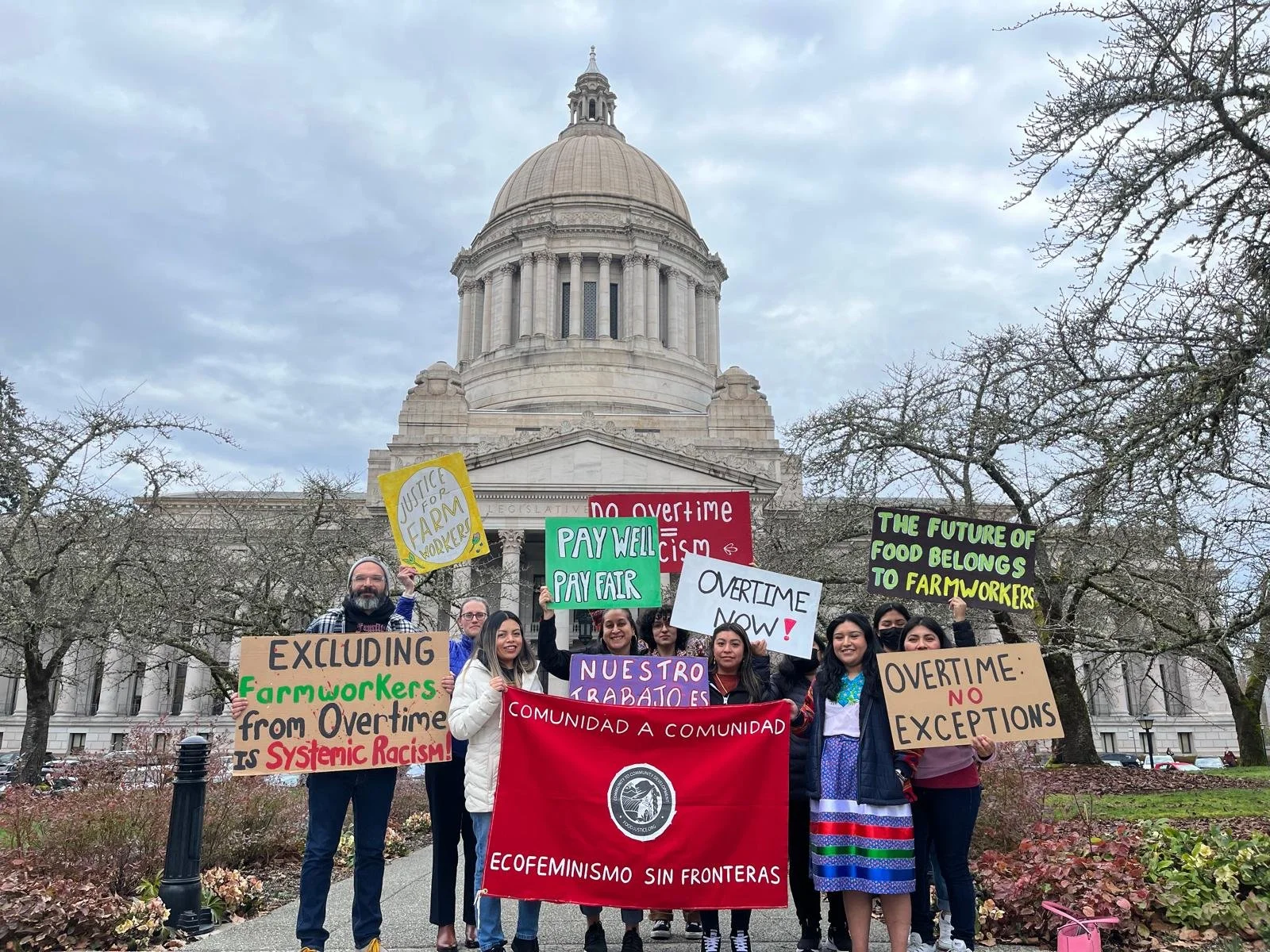
A bill critical to our efforts is currently making it’s way through the WA State legislator HB 2409 / SB 6045: Collective Bargaining for Agricultural Workers. This legislation sponsored by Rep. Sharlett Mena of WA 29th district, was co-written by Familias Unidas por la Justicia, and marks a major step forward in farmworker efforts to ensure safe and stable working conditions. 

Under the National Labor Relations Act (NLRA), most workers in the United States have the right to form unions and bargain collectively, but in the 1930s, Congress intentionally excluded farmworkers and domestic workers to secure votes from Southern Democrats who opposed labor protections for Black and Brown workers.
This racist exclusion persists today. As a result: Farmworkers lack the right to conduct union elections and to get union contracts if they win. Only two farmworker union contracts exist in Washington, each created only after years of successful boycotts and grassroots pressure from consumers, not because the law protected workers’ rights, but because of the farm workers organizing with “painstaking excellence” using the power of the marketplace and non-violent strikes and work stoppages. Courageous efforts with tremendous sacrifice by hundreds of workers. 

 This is the last major missing piece to give farmworkers the same rights that everyone else has in employment law. 

The bill would:

  • Create a process for farmworkers to organize and elect representatives.

  • Require employers (agribusinesses) to bargain with the workers for union contracts.

  • Provide clear oversight and enforcement through the Public Employment Relations Commission (PERC), which is prepared and committed to take on this role.

  • Reduce reliance on prolonged boycotts, strikes, lawsuits or federal claims that don’t protect farmworkers and are costly to employers.

We could not have gotten this far without your support, and we cannot get it to the governor’s desk without adding your voice to ours. Farmworkers help feed all families in every community and we now need maximum engagement from the people in Washington State who understand that farmworker protections are vital to a just and resilient food system.

C2C stands with FUJ as farmworkers and affirm our rights to self-determination and economic well-being. After 13 years of organizing and speaking truth to power by bringing powerful testimony from lived experiences to policy makers, another seed to growing farmworker justice will be planted. 

HB 2409 Sign in Pro or Contact Your Reps

SB 6045 Sign in Pro or Contact your Reps

Support WA Farmworkers! Sign in PRO for HB 2409 / SB 6045: Collective Bargaining for Agricultural Workers!

How Much is a Farmworkers Life Worth?

We are human and our lives are not to be sacrificed during a climate emergency!

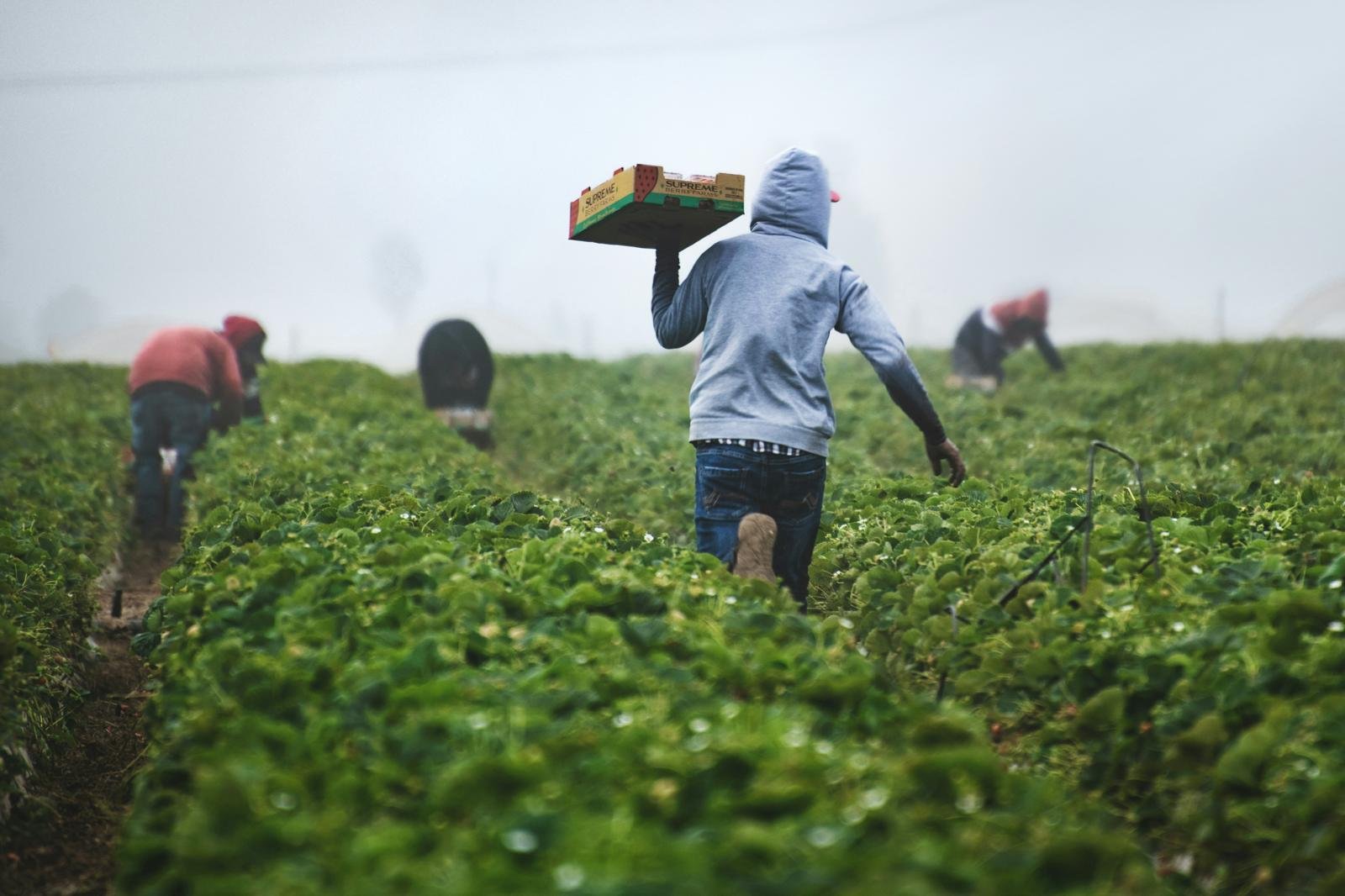
As floodwaters rose in Skagit Valley, the majority of farms and businesses  respected the County’s emergency evacuation alerts and ceased operations to allow workers to join their families and prepare for the coming floods. 

Despite the rising water and the ongoing evacuation alerts, two farms kept their workers in the fields working from before sunrise to after sunset, less than a mile from the river, some working with heavy equipment that gets easily stuck in the mud. 

Knutzen Farms continued to operate their potato packing shed with workers inside even as groundwater pooled around them. Skagit Valley Farm had people out harvesting brussels sprouts, from 7am to 7:45pm on Wednesday the 11th and Thursday the 12th. In the community during these days of heavy anxiety over the uncertainty of the Skagit River’s dikes breaking some farmworker families were missing their father, brother and sons because they had been called in to work. 

How much is a farmworkers life worth? 

To the farmers who employ them? To the state agencies responsible for overseeing their safety? To the families they work hard to support? 

Who is being sacrificed to a climate emergency? 

We have already lost two farmworkers in the last 10 years to the growing climate crisis. In 2017, Honesto Silva Ibarra died from overheating and smoke filled air while working at Sarbanand Farms on an H-2A visa from Mexico. Striking workers who walked the picket line in protest of his death and the poor working conditions were fired. Ibarra was only 28 years old and a father of two.

During the last  flood in 2021, farmworker Jose Garcia was swept away in his truck by floodwaters while on his way to work at a dairy farm. The cows needed to be milked. No employer or State agency has ever been held accountable for his death. 

How much is a farmworkers life worth? 

In the case of Ibarra, the fine leveled at Sarbanand Farms was initially only $150,000. After cooperating with the investigation, the fine was reduced initially to $75,000 and then finally to only $36,000 by Whatcom County District Judge Pro Tem, Dave Cottingham. 

It took two more years and a class action lawsuit before Sarbanand was fined $3.6 million by the Department of Labor and barred from hiring H-2A visa workers for 3 years. 

No action has ever been taken in Mr Garcia’s case, his was the only death in the flood in Whatcom County in 2021.

C2C is committed to supporting Familias Unidas por la Justicia as they fight to literally save the lives of their members through this crisis, which was caused by climate change. 

We ask that you stand with us! Our food security should not require human sacrifice! 

Ways to support Justice for farmworkers and Farmworker families affected by the flood: 

  • Contact your WA State Representatives and demand Paid Hazard Leave for lost wages during extreme weather events!

  • Commit to be ready to respond to emergency exploitative work incidents on WA State Farms by e-mailing c2cinfo@foodjustice.org with your contact information

  • C2C supports farmworker families who were affected by the current flood. Donations are needed both to respond to this immediate emergency as well as to change our systems, protect our local food system, and grow our communities’ resilience to  these emergencies which are increasingly frequent. 

  • Donate toys/funds for the children of members of Familias Unidas por la Justicia. Donations and funds will be accepted 11am-3pm at 224 Stewart Road, Mount Vernon through December 22nd. You may also donate by mailing cash cards or checks made out to Familias Unidas por la Justicia to P.O. 1206, Burlington, WA 98233

  • Protect job security for farmworkers in our community by opposing the exploitative federal H-Aa program. Call your Congressional Representative today and ask them to oppose these bills currently being proposed.

As people on the front line confronting climate change, just climate policy must include farmworkers!

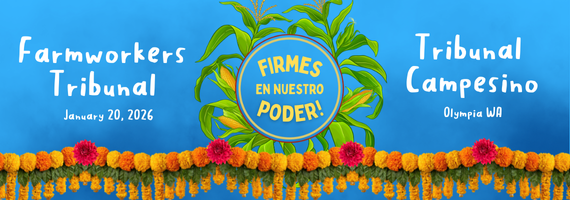
This is why the annual Farmworker Tribunal remains a critical event for advancing food and climate justice. On January 20, 2026, Farmworkers will gather from across the state to share their experiences and weigh in on the policy decisions that impact them the most. 

You can keep up with the latest information on our  Tribunal Webpage, and be the first to know about other upcoming events on our Event Calendar

Update Monday, Dec 15: An earlier version of the blog listed Knutson Farm, rather than Knutzen Farms as the location of farmworkers working on Dec 11. We apologize for the error.

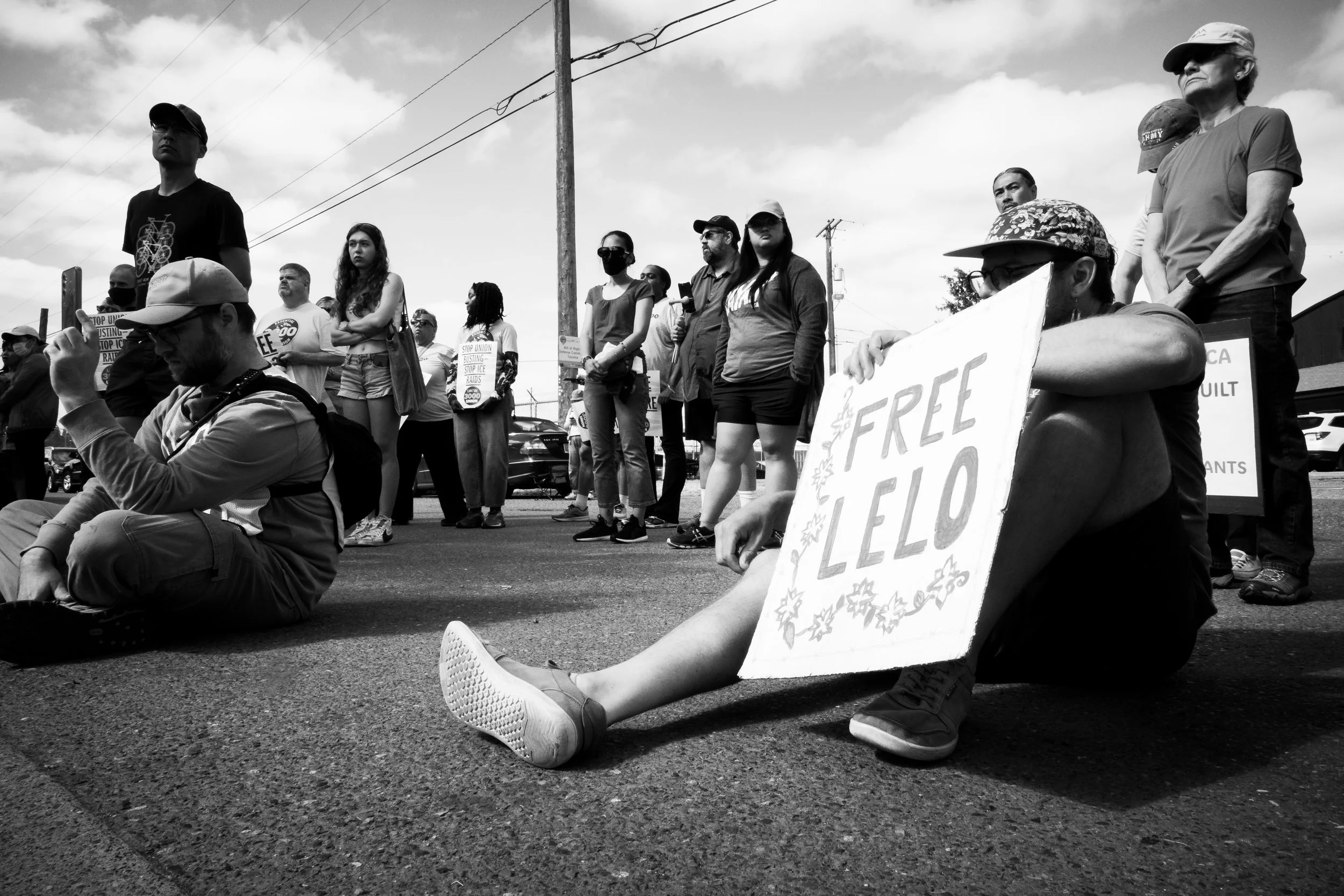
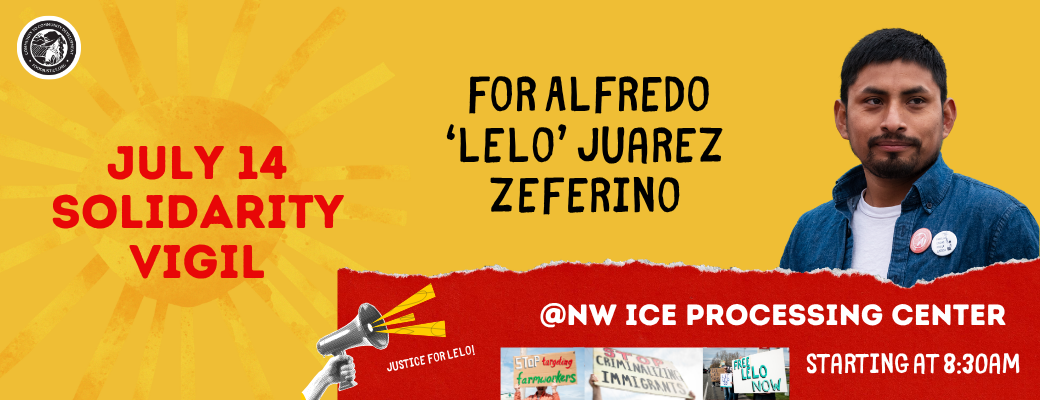
"No matter where I end up. I will continue fighting for justice along side all of you. " Alfredo 'Lelo" Juarez Zeferino's voluntary departure

sattva photo.

On July 14th, 2025 Farmworker leader and union organizer Alfredo ‘Lelo’ Juarez Zeferino requested voluntary departure from ICE detention in the United States. As of this statement, he is now reunited with family and friends in his hometown in Mexico. We are happy for him because he will be able to spend his birthday on August 6th with his parents and siblings.

That this departure was necessary for his dignity and safety represents a tremendous miscarriage of justice, and a profound loss for all of us. We are relieved that he successfully removed himself from ICE’s inhumane treatment. We value his wisdom and unwavering clarity that brought him to decide for voluntary departure. At a young age, Lelo had already played a critical role in the well-being of farmworker communities, and by extension, the well-being of all of us who benefit from farmworker labor in our food system. His commitment to justice and dignity is an extraordinary example that inspires and strengthens our community. 

The conditions at Northwest ICE Processing Center have always been unacceptable, and we respect Lelo’s choice to remove himself from the continued physical and psychological violence of detention. It was increasingly clear to all of us that due process was not being followed, and no justice would be found. The system is functioning as designed! To exploit the labor and assault the dignity of immigrants who dare to stand up against injustice. 

Sattva Photo

We would like to offer our gratitude to each and every one of you who participated in our campaigns for Lelo’s freedom. Thank you to everyone who showed up for our solidarity rallies at his hearing dates, thank you to everyone who shared his story and helped garner national and international attention. Thank you to everyone who wrote Lelo letters, visited him in detention, donated to his legal case, or purchased items from the Solidarity Store to support his family. Remaining funds will be used to support Lelo and his family’s transition into their community in Mexico. Lelo has been in the US since he was a child, and his younger siblings have never lived in Mexico. 

Though this was not the outcome we were striving for, our movements continue to grow in strength as we stand in solidarity together. 

Today we celebrate that Lelo is free, and again demand the freedom of all people detained by ICE! 

Resist ICE’s unlawful kidnappings! 

Stop attacking immigrants! 

Keep ICE out of our communities! 

Protect the workers in our food system! 

We are each other’s best defense.

Sattva Photo

Below is the letter Lelo wrote while still in detention on July 14, he asked we share with the people that have supported him: 

Hello everyone my name is Alfredo Juarez Zeferino “Lelo”. I am a farmworker and an organizer with C2C. I am also member of Familias Unidas por la Justicia. I want to say thank you to everyone for all you wonderful support. 

My story of organizing started on July 12, 2013  in a blueberry field in Skagit County, exactly 12 years and 4 days. Throughout these many years of fight for justice we have won major victory for farmworkers. For example paid rest break and overtime. I started working in the field a the age of 13 now I am 25. When I started working in the field we didn’t have rest break or lunch time. Since 2017 I have been working under a union contract and I am very proud of this. 

On March 25, 2025 around 7:15am after I left my house in Sedro Wolley. I was pulled over by a un-mark car within a few seconds my car was boxed in by many law enforcement vehicle. One of the ICE agent approach my car and asked to see my ID, I said okay. I asked the ICE agent to give me a reason why I was pulled over or to show me a warrant. My car window was rolled down a few inch, enough where the Agent and I had clear communication. Also I was asking to see a warrant the ICE agent broke my car window. He put his hand inside my car trying to unlock my car. I opened the door and raised my hand, I was put against my car and was put in handcuff. Since that day I lost my freedom. 

Now I am in this terrible place. The condition is really bad. The food is bad sometimes we ger our 3rd meal of the day, the morning of the next day. 

We all know that the immigration system needs a lot of work. Now that I am here I am seen just how bad things are. So far I have gotten Zero Justice. 

I encourage everyone to stay strong and keep fighting. There are many actions that you be part of for example show up at a protest. Attend your city council meeting. Use your first Amendment right. Talk to your representatives let them know your concerns. 

I have very limited options but I want everyone to know no matter where I end up. I will continue fighting for justice along side all of you. Again thank you for your support. 

One of my favorite chant is “Uno Somos todos. Todos somos uno.” We are all one. One we are all. 

Si se pude.

Alfredo 'Lelo" Juarez Zeferino: July 14 Immigration Hearing and Opportunities to Support

Update on Lelo:

Since his violent detention by ICE in late March, Lelo has remained in federal custody in Tacoma as he attends scheduled hearings with his legal team. Previous attempts to have his case dismissed, or for his release on bond have been dismissed or denied. Monday July 14th is the next scheduled hearing for his case, and we want to let him and everyone else know that we are watching his back. 

Farmworkers are being targeted across the county as the federal government enacts their violent policies against immigrants and their families. We have said it before, and will continue to shout loudly: The violence of ICE is a test, to see what we will tolerate, to see how much violence we will turn a blind eye towards. The well-being of farmworkers who put food on our plate every day is not separate from the well-being of the community as whole. We are watching! We will continue to resist!

Scroll down for solidarity actions you can take today in support of Lelo!

Coverage of Lelo’s story in the news: 

From the Guardian: Ice ‘politically targeted’ farm worker activist Juarez Zeferino, colleagues say. Detention comes amid Trump crackdown against perceived political enemies, including immigrants and labor leaders. Read more >

From Cascadia Daily News: Rep. Larsen meets with farmworker activist ‘Lelo’ in Tacoma detention center. Facility is understaffed, detainees need legal representation, Larsen says. Read more >

From Cascadia Daily News: Detained farmworker activist joins federal lawsuit against ICE, immigration court. Alfredo 'Lelo' Juarez Zeferino has been detained since March Read more >

We cannot accept this unjust detention, and will continue to show up to support Lelo and other farmworker leaders targeted by ICE and other government agencies. 

CALL TO ACTION! 3 Ways You Can Support Lelo:

First, you can join C2C for a solidarity vigil  next week, Monday  July 14, 2025 at NW Ice Processing Center at 1623 E J St, Tacoma starting at 8:30am for an action in solidarity with detained Farmworker leader and organizer Alfredo ‘Lelo’ Juarez Zeferino.

Carpool available from Whatcom County. For questions, or to RSVP for the carpool, contact Liz Darrow at lizdarrow@foodjustice.org or call/text 360-220-9065. 

Join us in-person to make a show of strength in numbers!

Second, you can amplify our call for justice! Contact your elected officials to ask for his release and/or share his story online. Lelo has specifically asked for Senators Patty Murray and Maria Cantwell to visit him at the NW Detention Center. Find their contact information below to help him amplify that request.

Senator Patty Murray: https://www.murray.senate.gov/write-to-patty/ | (253) 572-3636

Senator Maria Cantwell: https://www.cantwell.senate.gov/contact/email/form | (253) 572-2281

Write to him: Alfredo Juarez A205273237 | 1623 J St #5 Tacoma, WA 98421-1615

We cannot afford to comply in advance!

All eyes on Los Angeles! We share your grief and outrage in the wake of the ICE raids and kidnapping of your neighbors. Our solidarity with and gratitude toward the people of Los Angeles! By standing up for your communities you are also standing up for all of ours! 

The kidnapping of our neighbors and community members endangers our communities . It creates cultures of terror and violence. Immigration and Customs Enforcement (ICE) is less than 20 years old, part of the Department of Homeland Security which is also younger than C2C. We remember a time before these violent institutions, and we hold our vision of a time when they no longer exist. 

The deployment of the national guard against the wishes of Governor Newsom for the first time since the Civil Rights protests is a red flag for totalitarian rule. No ‘exceptional security situation’ excuses the use of the world’s most powerful military against our own communities. If not challenged now, ICE will continue to seize power and wield violence against families, immigrants and citizens alike. 

This is a test to see what the people of Los Angeles will tolerate. The people of Los Angeles see the clear signs of authoritarianism and are rising to the challenge. We at C2C see it and we will not allow this violence to grow unchecked and unchallenged. 

The display of facism is also growing here in our own communities, as our local ICE facilities test the residents of Skagit, Whatcom, and Spokane to see what we will silently tolerate. Farmworker leaders like Lelo are being persecuted for protecting other workers. Families unlawfully held in detention centers outside of due process, raids on our roads and workplaces, these actions are connected to what is happening to Los Angelinas. 

Where are our local elected officials? Where are our state and county officials with the power to take action to protect the communities they serve? 

We are responsible for denouncing and opposing the rise of totalitarian governments- and each of us have opportunities to take action. Our actions now are critical as our rights are being erased. Join us in protecting and strengthening our communities for everyone:

  •  Become a Solidarity Member of Community to Community, where you can contribute your time, skills, and resources to advancing food justice and building a solidarity economy.

  • Keep an eye on our socials and other channels to follow the case of Alfredo ‘Lelo’ Juarez Zeferino, farmworker organizer detained by ICE in late March who remains in custody. Join your voice with ours in demanding his release. We will continue to share opportunities to act in solidarity as his case continues.

No one is free until we are ALL free!


Update on Alfredo “Lelo” Juarez, currently being held at the NW Detention Center in Tacoma WA. 

To our friends, allies, supporters, and community members, we are grateful for the nearly 200 people who responded to our emergency call to action to demonstrate with us outside the ICE Detention Center in Ferndale. A flood of voices also called on WA’s Attorney General and Governor to release Lelo from this unjust detention. Keep up the pressure. This is a time for coordinated action to get him released as soon as possible. 

Our voices are strongest together! Join us in telling ICE: No more! No more attacks on working families! No more attacks on our community members! We are not taking this quietly and as a community we demand the immediate release of Alfredo Juarez!

Collaborate and coordinate for our common purpose: Release Lelo! Release everyone in the NW Detention Center!

Close down this for-profit private prison that breaks up working families!

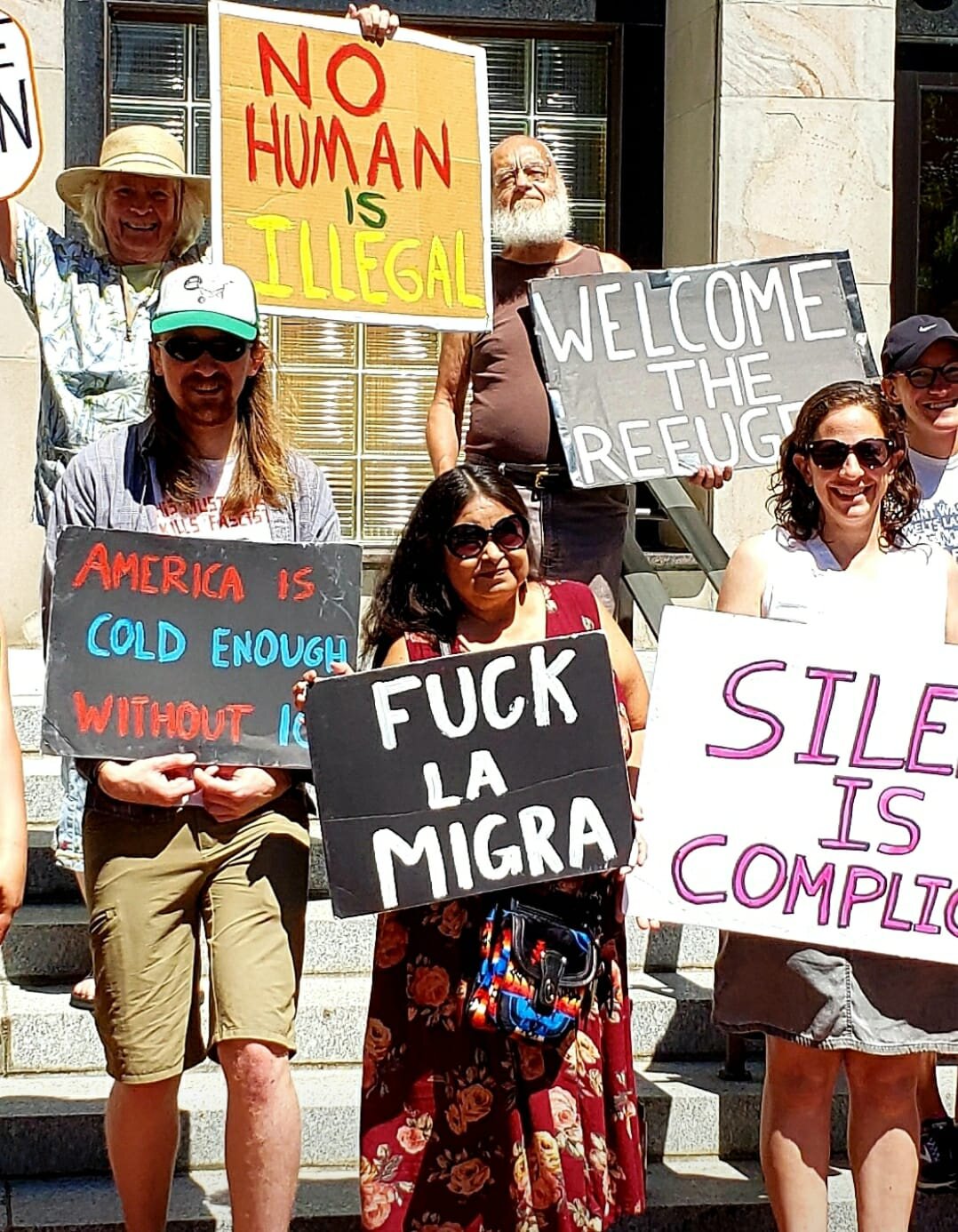
Whatcom and Skagit county residents are watching ICE and Border Patrol after multiple first-hand reports that ICE is taking people on their way to work and at their workplaces. It is clear that an assault on workers is underway.

Solidarity actions you can do today: 

Join the Washington State Labor Council in a mass solidarity action at the NW Detention Center on Thursday March 27th at 5:30 pm. For more information contact Dulce at (509) 833-3096.

Please call or text this number 360-961-2802 if you are a Whatcom or Skagit county resident and want to watch ICE and Border Patrol, as they watch and assault our communities.

If you are based south of Skagit County (Snohomish, King, Pierce, Thurston and beyond), we are asking you to please show up in solidarity with Lelo at the NW Detention Center in Tacoma ASAP, bring your signs demanding ICE release Alfredo Juarez. Parking is available on the street in front of the prison. If you are traveling via Public Transit: The NWDC is about 1.2 miles from the Tacoma Dome Bus Station, located at 610 Puyallup Avenue, Tacoma, Washington. The address for the facility is 1623 East J Street, Tacoma, WA, 98421. 

Keep calling to demand Lelo’s immediate release!

Call our Congressional Representatives to thank them for working to get Lelo released. Ask them to please keep going:

Food Chain Workers Alliance has put together a petition that sends multiple state elected officials your demand that Lelo be released immediately, as well as connects you with their phone lines: bit.ly/FreeLelo

WA Representative Rick Larson https://larsen.house.gov/contact/contactform.htm?zip5=98281&zip4= | (425) 252-3188

Senator Patty Murray: https://www.murray.senate.gov/write-to-patty/ | (253) 572-3636

Senator Maria Cantwell: https://www.cantwell.senate.gov/contact/email/form | (253) 572-2281

Join our solidarity membership:

https://www.foodjustice.org/solidarity-membership

Donate to support Lelo’s legal defense fund: 

You can donate online via our website: https://www.foodjustice.org/donate-1

Checks can be mailed to: Community to Community Development                                                                                                            PO Box 1646 Bellingham, WA 98227

Please watch our social channels for the latest updates:
Facebook | Instagram | Bluesky

We will not be divided: Take action to oppose WA HB 1597/SB 5487

We will not be divided: Take action to oppose WA HB 1597/SB 5487

The overtime law is good, the employers have taken a political and greedy position against their own skilled workers and have betrayed a social contract between farmworkers and their communities. This opposition to overtime pay for WA State farmworkers is all about profit and greed and the industry's yearning for a workforce as close to slavery as they can get.

Read More

The Pursuit of Happiness

This July 4th we invite you to read and consider the founding documents written collectively in 1776 by a group of people seeking to establish the United States of America. We find ourselves in a critical political moment where there is a very real attempt to reinterpret these founding principles towards the establishment of a fascist state.

The Declaration of Independence, the Constitution and the Bill of Rights are being used to justify today’s extreme exploitation in the fields, and to continue and even speed up the destruction of our ecosystems we depend on. We ask that you read these words that have inspired countless millions to attempt to create what many call Democratic governments. Those of you who have secured privilege because of the rights gained through struggle and vision towards true freedom and happiness - for all and have the day off from work, read before you gather with your families and prepare to enjoy the fireworks.

While you celebrate the liberation from the oppression of a King and the British Colonial power, remember that many in our country are still not free, and that a few have become the ruling class, a new colonial power, intent on rolling back protections for women, workers, young people, elders, immigrants, people of color, and poor people. Consider that the freedoms guaranteed in the founding documents depended on excluding enslaved workers and taking land and waters from our Indigenous neighbors by force.

We as farmworkers are your brothers and sisters that still have many freedoms and rights yet to gain- TODAY WE TOIL SO YOU MAY HAVE DELICIOUS FOOD AT YOUR CELEBRATION, we live in poverty, yet we strive for happiness for our children - and to secure a just future for them.

The few wealthy and powerful people who comprise the ruling class are celebrating in opulence. They have gained power in the courts and are working hard to convince workers to give up our power so they can further cement the US into a stronger global colonial power led by a new type of King, with a submissive workforce.

We at C2C believe that ANOTHER WORLD IS POSSIBLE. At this moment, this 4th of July, we ask that you participate in building a world that secures justice, true democracy that welcomes everyone, and a healthy environment for us to grow our food in. And celebrate the power we build and wield when we work together for a just future.

Photo by Tim Mossholder

Bringing the Butterflies Home

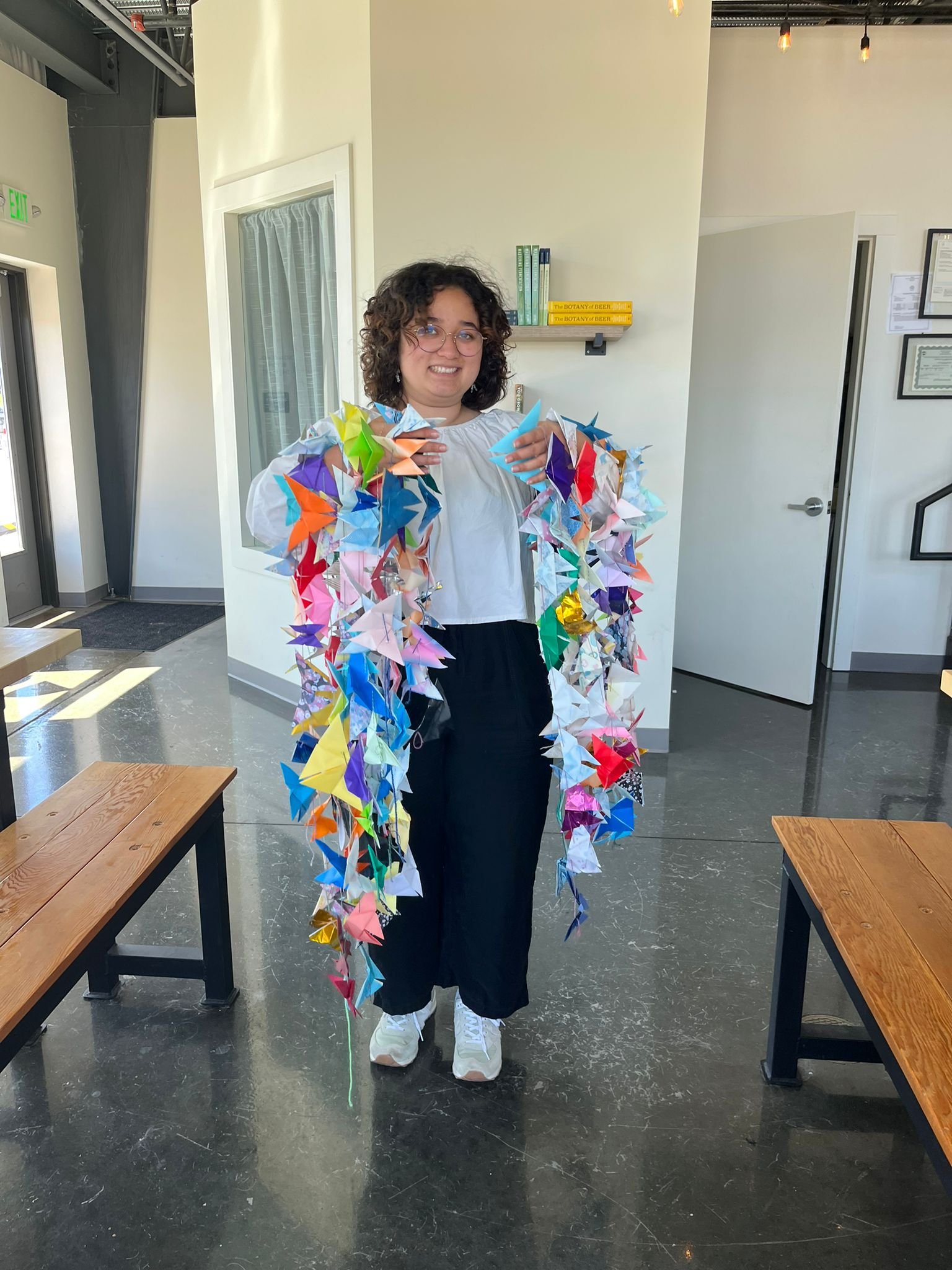
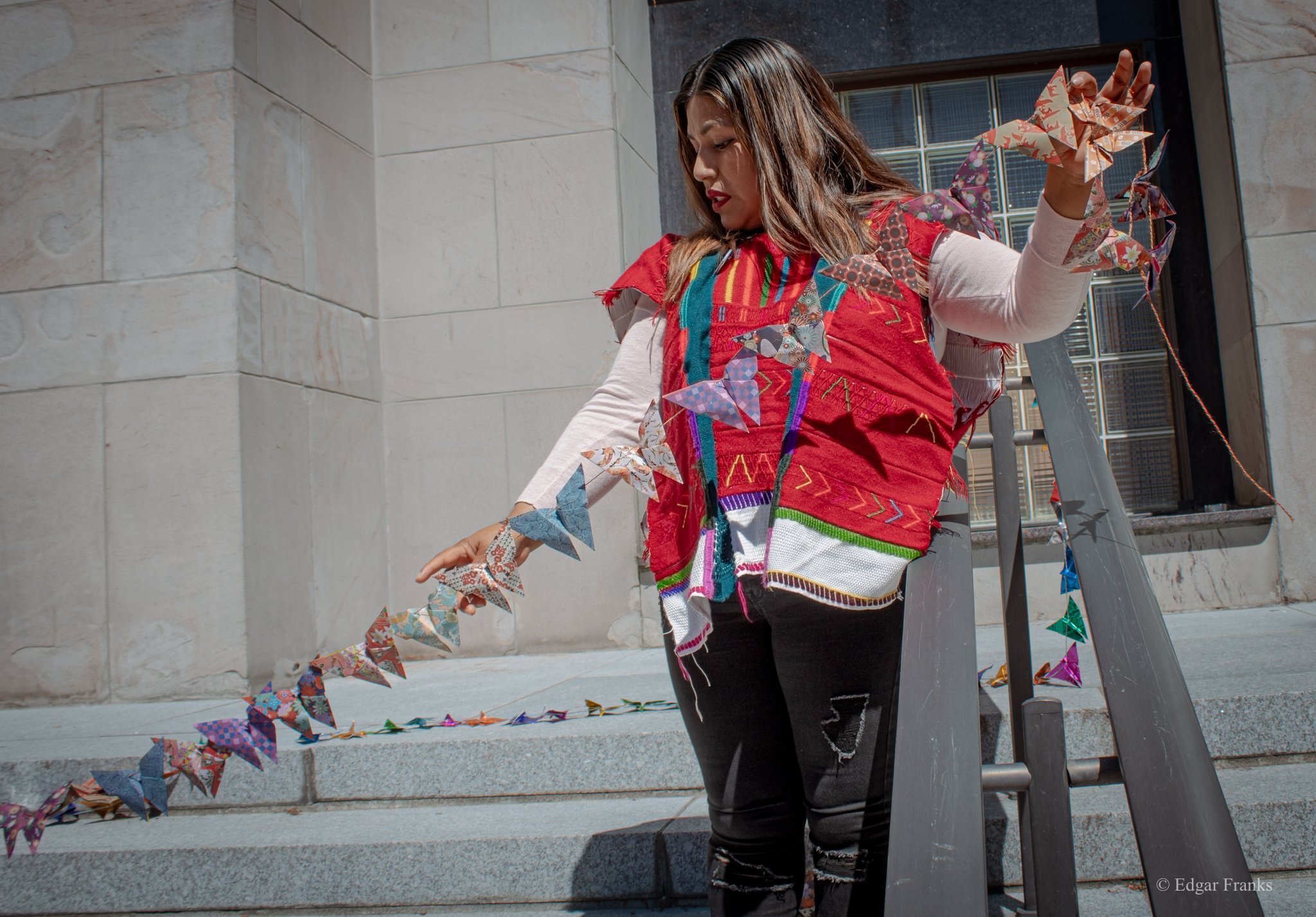
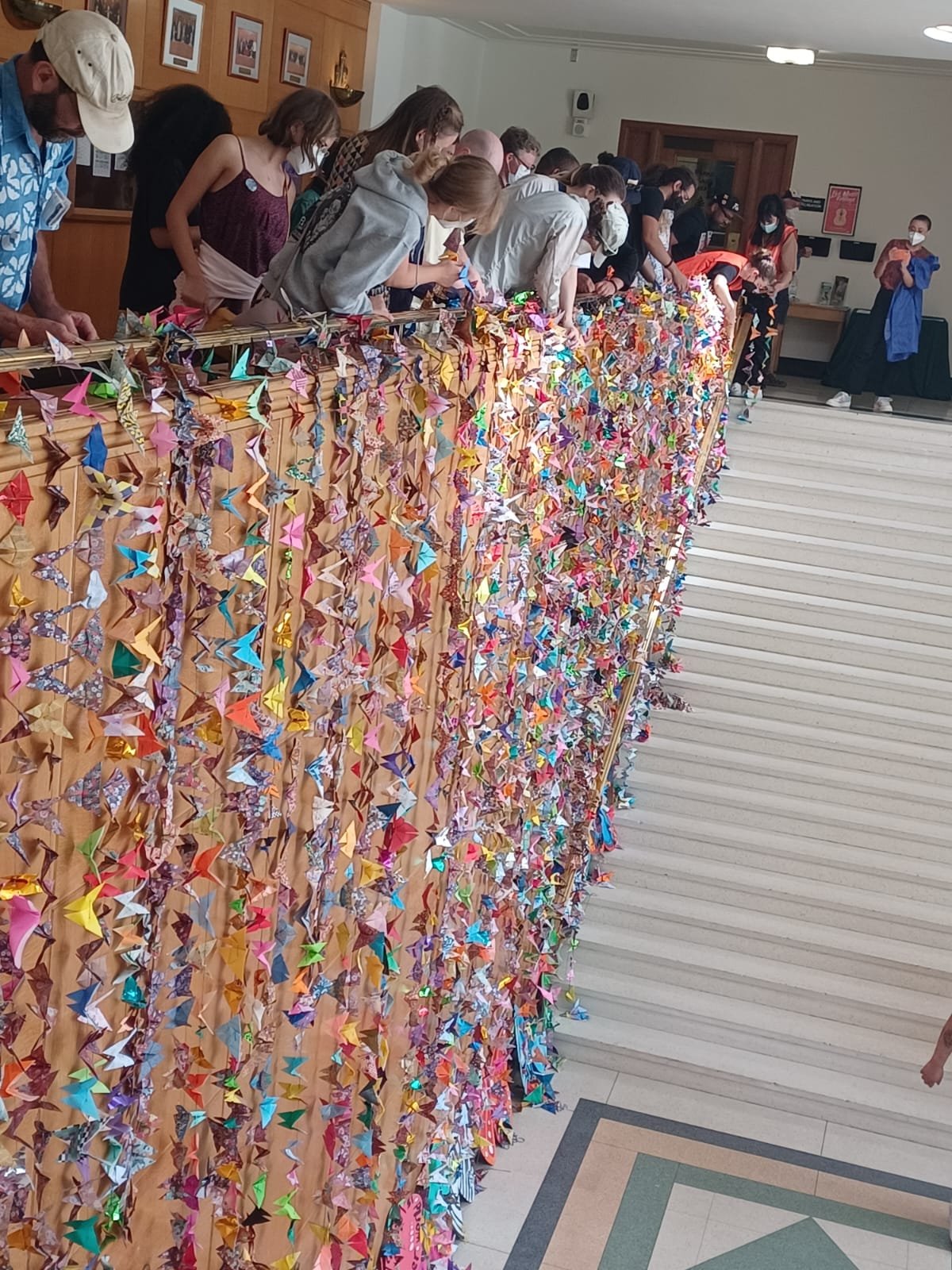
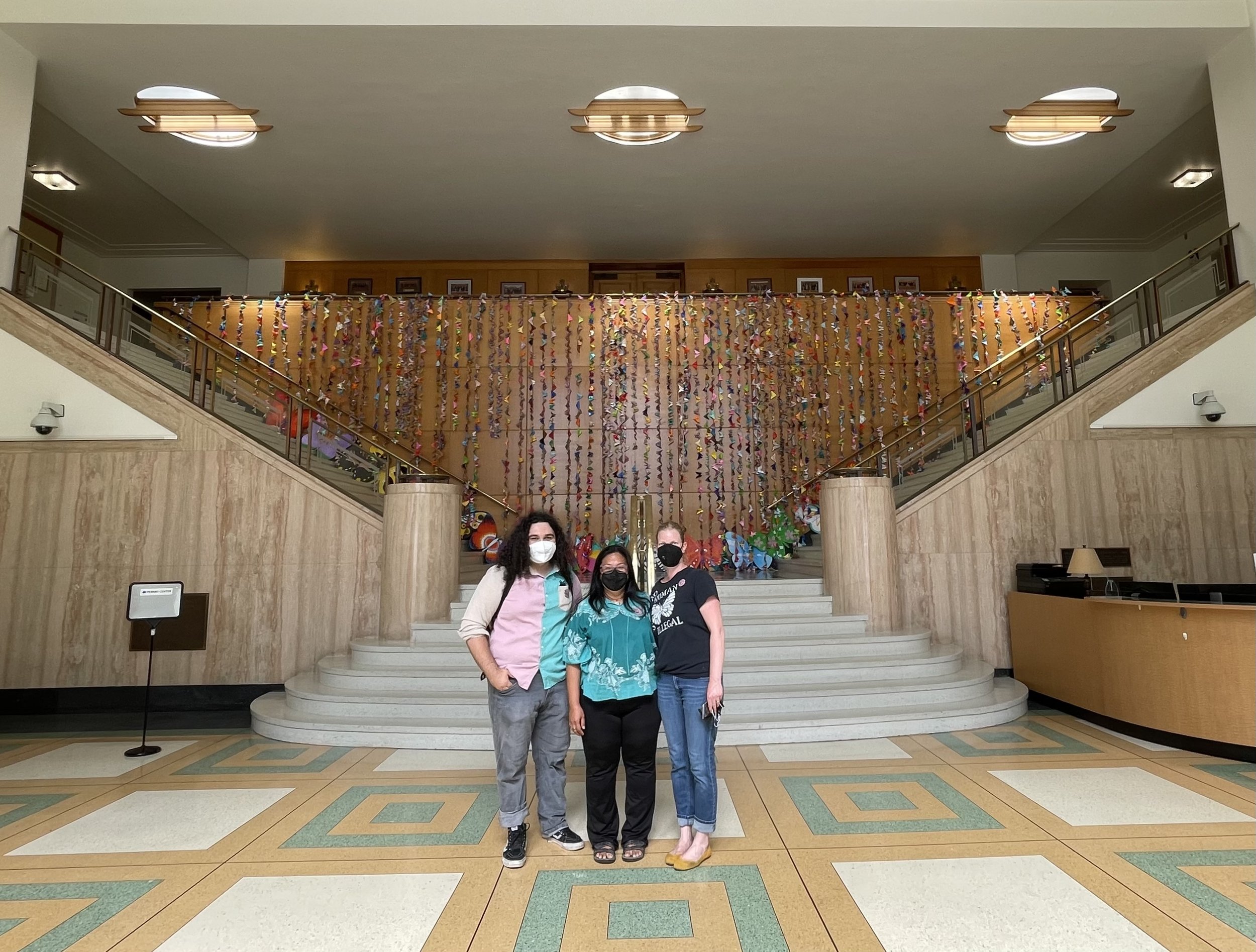
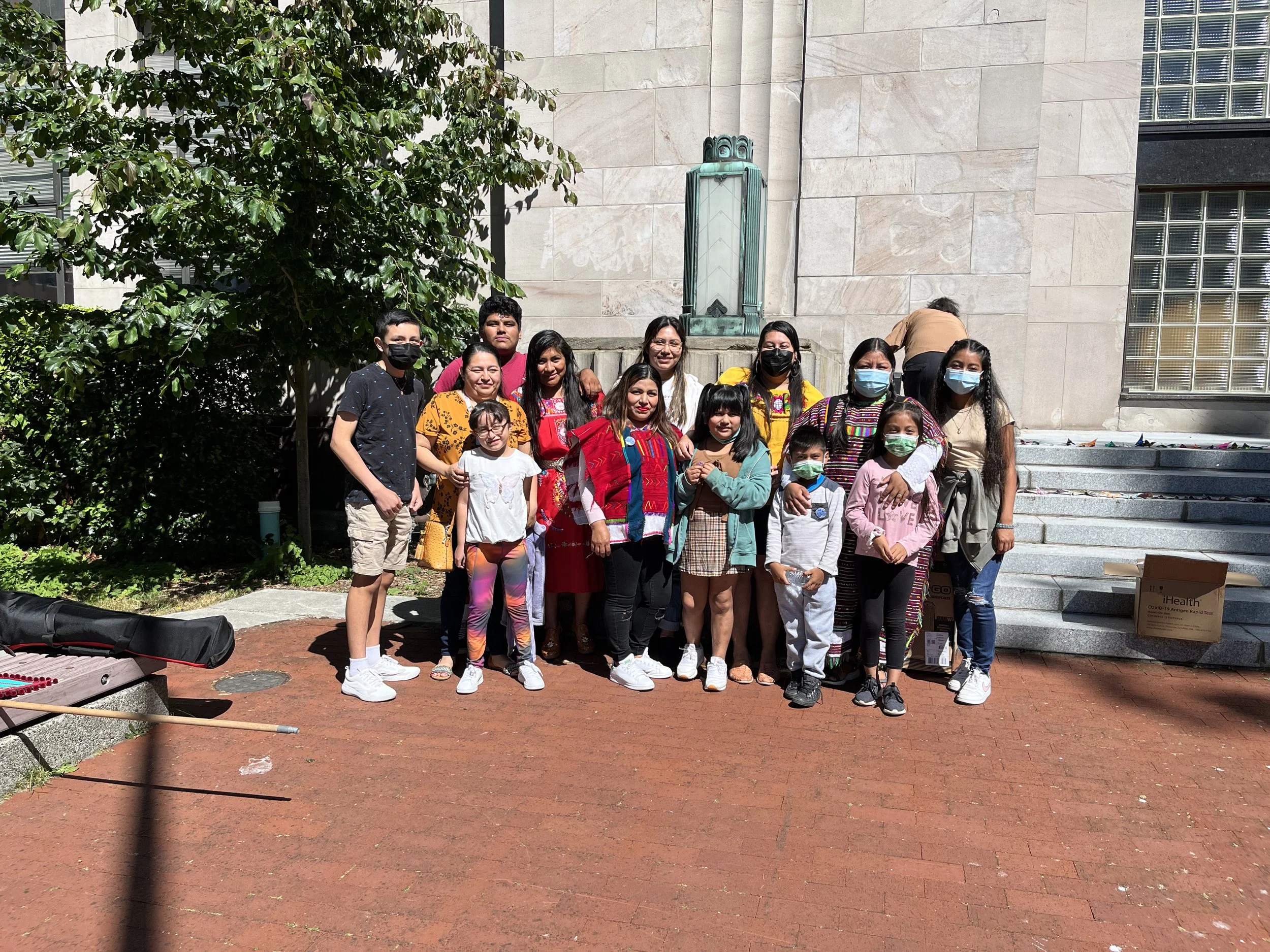
Two years after the launch of the Migration Makes Us Stronger butterfly campaign, the remaining origami butterflies out in the community will be coming home to roost. On August 5th 2022, C2C, in solidarity with a number of partner organizations, immigrant community members and their families gifted 10,000 origami butterflies to the city of Bellingham to lift up the voices and lives of the immigrants who make our community more vibrant and rich together.

And when the mayor’s office asked to have the gift removed, those butterflies were given a home by local businesses, community organizations and faith organizations. We want to especially thank our friends at Aslan Brewery, Ponderosa Beer and Books, and NW Yarns, who have hosted butterflies continuously since the campaign began. We depend on one another for support and it will take all of us working together to realize our vision for a future where everyone gets to thrive and live full, vibrant lives.

migration makes us stronger event 2022


In February of 2024, despite dozens of letters of support from the community for the continued work of the Immigration Advisory Board, the Bellingham city council approved an ordinance suspending the IAB indefinitely.  Today, that suspension continues to represent a barrier to full and just representation and has stalled progress toward a necessary city-funded Immigrant Resource Center. Immigrants continue to live and work in Bellingham and Whatcom County and every day have to face unmet needs, despite the taxes we contribute to the local economy. 

Kira from c2c’s civic engagement team gathering butterflies from ponderosa beer and books

The striking beauty of the butterflies has faded into the background as immigration issues continue to evolve locally and on a national level. While federal politicians use immigrants as pawns in political posturing over policy that affects our real lives, the beauty of migration remains vital to our community. To preserve the physical art, we are choosing to collect the butterflies so that we might one day bring them back to remind everyone who lives in the city of Bellingham that migration is beautiful, that we are all connected, and that migration makes us stronger.


URGENT IMMIGRANT JUSTICE UPDATE!

Last week, on January 2nd, C2C leadership and immigrant community members were stunned to witness Council Member Hannah Stone, an immigration attorney, introduce a draft ordinance to city council with the intention of suspending the Immigration Advisory Board indefinitely. It is difficult to describe the feelings of shattered hope from our immigrant constituents, especially when a bilingual immigration attorney is leading the effort to dismiss their leadership.

The Immigration Advisory Board was established by ordinance in a unanimous city council vote on December 2019. Since that time, the IAB has become the only City of Bellingham Board or Commission to provide language access to City residents participating in official governance processes. Interpretation in Spanish, Punjabi, and Russian is available at all public meetings of this Board only, with the agreement that additional languages can be requested for interpretation by community members who want to participate. Because of this access and the board’s intentionally democratic processes to prioritize equitable participation, the IAB is the only place where immigrants in Whatcom County can and do bring the issues that are impacting their lives.

In August 2022, immigrant community members and allies hand made and delivered thousands of origami butterflies to city hall in a gift which signified hope and willingness to move forward together toward equity in city governance. The mayor and city council rejected the gift and asked immigrants to take the butterflies down. Today, you can still see origami butterflies hanging all over Bellingham in businesses who support the effort to create a city funded Immigrant Resource Center.


DON’T LET THE CITY SHUT THIS BOARD DOWN!

Email city council and the mayor now and tell them that you value equitable participation for immigrant community members. 

Immigrants are under attack at the border, shipped out like cattle to cities across the country, and being used as political pawns to fund wars overseas. This effort in Bellingham is a local ray of hope, led by immigrants, to provide dignity to their families using tax dollars they know they have paid into the City economy to fund an Immigrant Resource Center. 

The task of creating an Immigrant Resource Center can only be successful when immigrants lead it using the Immigration Advisory Board and the democratically allowed Civic Process. 

SPECIFIC WAYS YOU CAN HELP NOW

  1. Attend the Immigration Advisory Board meeting on January 16th at 6:30 pm in person, at 2221 Pacific Street. Council Member Stone has said that she will attend the meeting to answer any questions about her ordinance to suspend the board. We need a strong showing of community support to witness that meeting.

  2. Contact the new mayor, Kim Lund, and tell her that you support the work of the Immigration Advisory Board. This is no way to start her tenure as a Mayor. Now is not the time to shut it down! She can take the opportunity to initiate a fresh and collaborative relationship with the IAB. You can email the mayor at mayorsoffice@cob.org

  3. Email the city council in general and your City Council representative in particular, and urge them to vote NO on the ordinance to suspend the Immigration Advisory Board 

City Council: ccmail@cob.org

Hannah Stone, Ward 1: hestone@cob.org

Hollie Huthman, Ward 2: hahuthman@cob.org

Dan Hammill, Ward 3: dchammill@cob.org

Skip Williams. Ward 4: ehwilliams@cob.org

Lisa Anderson. Ward 5: laanderson@cob.org

Michael Lilliquist, Ward 6: mlilliquist@cob.org

Jace Cotton, At-Large: jacotton@cob.org 

Ask five friends to email the mayor and city council. Bring them with you to the IAB meeting on January 16th.

Immigration Advisory Board member Tara villalba presents a proposal for a city funded immigrant resource center to city council in october 2022

Community to Community Development has always supported immigrant leadership addressing inequities in the City by using processes that develop solutions with co-governance. Since 2019 the Immigration Advisory Board has put forth the following specific recommendations based on input and priorities from immigrant community members. These recommendations are an indication of strong visionary leadership: 

  1. Establish a city-funded immigrant resource center, as has been done in Seattle, San Antonio, New York, and numerous other cities, in collaboration with the Immigration Advisory Board and with ongoing input from immigrant communities.

  2. Provide language access to allow civic participation in all governing spaces, including the city website and in regular council, board and committee meetings.

  3. Improve how data is gathered and analyzed, ensuring there is no racial bias, then implement findings of fact to provide recommendations and advice from the Immigration Advisory Board relevant to city policies and practices to be in compliance with the Keep Washington Working Act and other state laws and data collected by the Immigration Advisory Board.

  4. Support community engagement and integration efforts to ensure that immigrant families have adequate access and information to participate in decision-making spaces on issues that impact immigrants’ daily lives, including equitable and just access to affordable housing, healthcare, education, food security, transportation, civic rules and regulations and workplace safety. Include IAB in the board appointment process to ensure majority immigrant participation.

  5. Establish protocols for language and culturally appropriate engagement and dissemination of information to immigrant communities during climate disasters and other emergency events.

The city has resisted these efforts by not responding to the ongoing work of the Immigration Advisory Board and by refusing to engage in good faith. For three and a half years, the IAB has attempted to collaborate with and advise the City and brought in experts from the ACLU, the Office of Immigration and Refugee Affairs, Immigration Liaison from the City of San Antonio, Cities for Action, the Whatcom Racial Equity Commission and many more to share information with the city about best practices for equity and resource distribution. In October 2022, the IAB gave a detailed presentation to the city council, with a budget and operations proposal for an immigrant resource center. In November 2022, a proposal to fund the Immigrant Resource Center failed by a city council vote of 4-3. What did pass, by a vote of 7-0, was a Request for Proposals to fund an outside contractor who would research and deliver a needs assessment to the city for what an Immigrant Resource Center might do. Immigration Advisory Board members did due diligence with city representatives and scored and interviewed the two organizations that applied in July 2023 and made a recommendation by choosing one of the two orgs as requested. Since that time, no further movement toward awarding that contract has been made by the city. Now with a proposal to suspend the Immigration Advisory Board indefinitely, all of the civic volunteer work that has been done by immigrant community leaders up to this point is at risk of being removed from the publicly accountable process under the auspices of the IAB.

Despite all of these bureaucratic setbacks, the IAB is a historic victory for immigrant families and for our community as a whole.

There is no other space within the city where any language access or participation is accessible. Because of over 15 years of immigrant rights advocacy by C2C, 7 out of 8 of the currently seated board members are immigrants. We are proud of the work accomplished by this board and with this community. The IAB, because it is led by immigrants, creates a space where immigrant community members know they can come and bring their issues regarding housing, health, climate crisis, resources, and unfair labor practices to the city government. This is the first time this has happened. We are not willing to allow the city to shut down the only equitable and diverse active democratic space for immigrants created by immigrants in Bellingham, without calling it out for what it really is, a blatantly punitive undemocratic public shaming of immigrant leaders that have made an effort to be recognized as dignified contributing members of our community

Members of the Immigration Advisory Board are asking their work and leadership be respected and their Board not be suspended, as they have said on the public record. 

We don’t know where this is going to go.

C2C will continue to support the voices of immigrant leaders in the IAB, and any effort that will provide equitable representation for immigrant families in our community. We are asking all of our allies to come forward now and show support for this important historical work. Since The Minutemen attacked immigrants in 2006, you have marched with us, stood in vigils, wrote letters, made calls, traveled with us to the NW Detention Center to help release detained family members, accompanied fathers to immigration court, donated food, clothes for families suffering trauma from ICE raids, supported immigrant children left behind when their parents were detained. This is the time to once again stand with C2C, farmworkers and Immigrant families to move forward with systemic change. 

Thank you for continuing to show up in solidarity with immigrant community members. Email us for more information or to get involved in supporting this work.


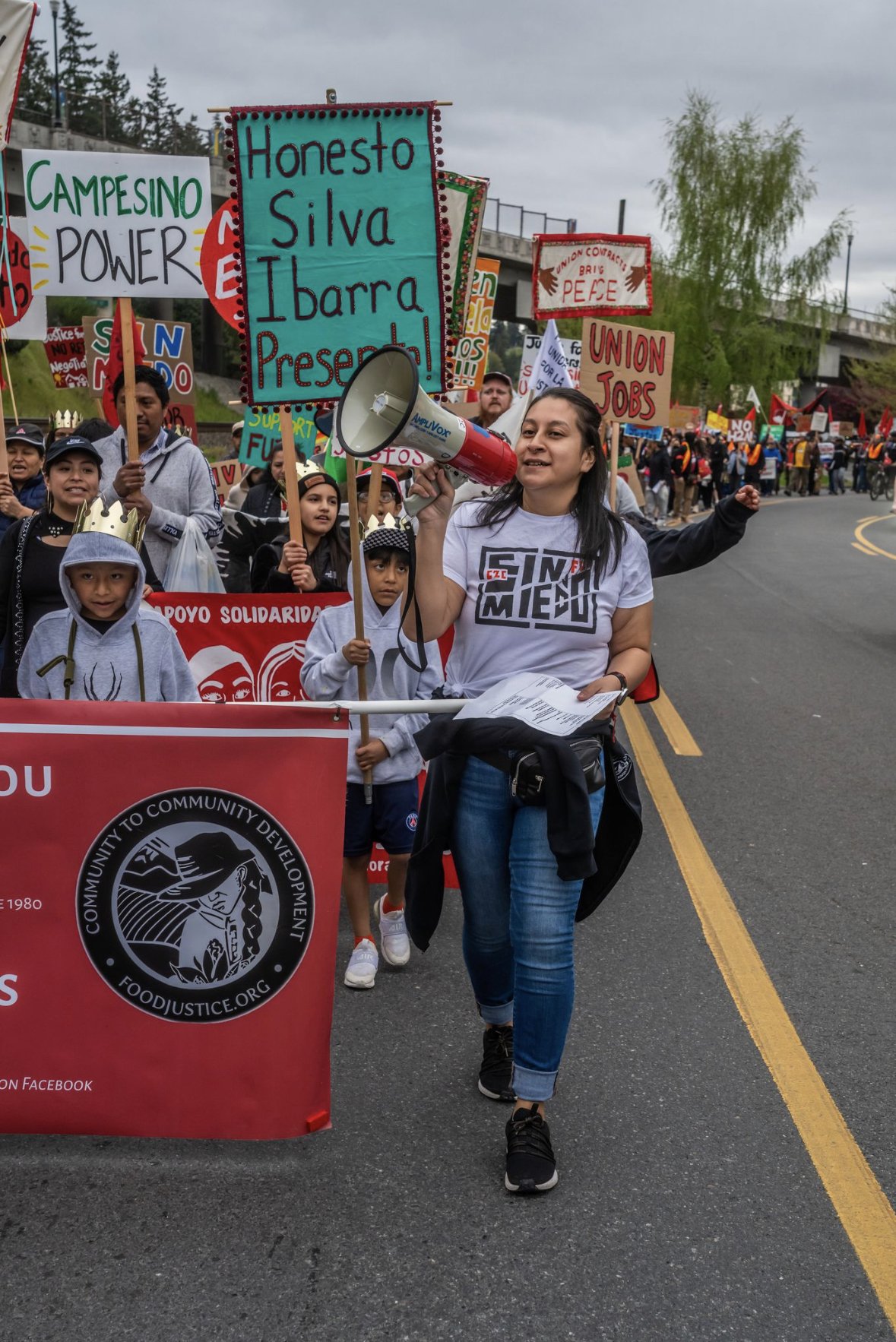
Visual Companion - Community Voz S11 Ep 2 & 3: La Marcha Campesina 2023

These episodes, in both English and Spanish, take you along the route of the Marcha Campesina 2023 from the perspective of attendees, organizers, workers, and the promotoras. Our long walk through the streets of Mount Vernon happened just a day before International Workers' Day, in celebration of the workers in our community. As a companion to these episodes, we are honored to share the beautiful work of David Bacon and Bodi Alexander Hallett of Sattva Photo, who diligently photographed the events of the day.

You can listen to the episodes here:

CV S11 Ep 2 (English)

CV S11 Ep 3 (Español)

With Gratitude for Gustavo Esteva


by Tomas Madrigal

“’Autonomy,’ said Don Gregorio, an old Yaqui Indian, ‘is not something we ought to ask for or that anyone can give us. It is something we have, despite everything. Its other name is dignity.’” Lines penned by the late Gustavo Esteva in 2003 after having walked with humble intellectual giants that changed Mexico forever after an uprising in 1994, an experience that led the Mexican activist to take on the identity of a, “deprofessionalized intellectual.” His brilliance, as an academic wasn’t that of an intellectual in isolation, but of one that had the ability to listen to those in community around him and had a willingness to weave the different strands into stories meant to create a cognitive dissonance enough for anyone that was reading to take a moment to pause, and reconsider what was taken for granted or as a given.

I have the honor of acknowledging this elder, with all of his patriarchal faults, as someone that also helped lay a foundation for action to research to action so that we may get just a little bit more free, even if it had to do with the way that we managed our excrement. Don’t believe me, take up the task of reading the dense Grassroots Postmodernism: Remaking the soil of cultures (1998). These works, were among the first that I read as a graduate student who was part of forming the first satellite Universidad de la Tierra in the United States. It was in these formative engagements with his grappling with his own deep patriarchy, that I began to challenge my own as a necessary step towards humility to be able to walk with the people. The first time was during the Other Campaign stop in Tijuana, hitching a ride with Joel in Los Angeles, who would become a lifelong friend, we went to Mitín after Mitín, in preparation. Shortly after, we would end up as part of a brigade that walked with the Cúcapa in Baja California, as they struggled for fishing rights that were diminished due to dams on the US side of the border that shriveled a river that was their ancestral lifeblood and had to venture further into the Gulf of California, an ecological zone to survive. A couple years later, after standing up the UniTierra Califa’s Santa Barbara satellite that supported facilities for workers of color to take their union back, we were called once again to form a brigade, this time to Vicam, Sonora to witness the Congreso Nacional Indigena make pacts about defending territories and water, several years before Standing Rock and a few years before several battles in Mexico for Indigenous Autonomy.

Gustavo Esteva, in his writing, and example was a seed, justly so, unitierra refers to it’s workshop as a semillero; whether in Chiapas, Puebla, Oaxaca, Califas, or Seattle. I remember that he was very sensitive of being remembered as the founder of the UniTierra movement. For him it was important because the Unitierra model was built on the idea of apprenticeship, where “students learn the skills of the trade or field of study as apprentices of someone practicing those activities” without having to pay a university to gain those skills. The UniTierra model isn’t alone in this method, in fact prisoners in Washington State, use the Each One, Teach One principle from Black organizing to create the T.E.A.C.H. program inside prison walls precisely because lifers and those without citizenship status were structurally denied the ability to improve their education through university programs. I like to think of Esteva’s founder syndrome with UniTierra as the last great battle he had with his own patriarchy, as the apprenticeship model was the common wind among different, diverse and global liberation movements as we can now see with recently published scholarship about struggles across the world.

I have nothing but gratitude for those like Gustavo Esteva, whose shoulders the next generations stand upon, just a little more free than we started.

Abolish the H2A Program!

Statement by the Dignity Campaign

In November 2021 the U.S. Attorney in Georgia filed a case against 24 growers and labor contractors for abusing workers in the H-2A temporary contract labor program.  The complaint included two deaths, rape, kidnapping, threatening workers with guns, and growers selling workers to each other as though they were property/slaves.  While shocking, these abuses are just the latest, and commonplace.  For decades the H-2A program has abused workers recruited from other countries, and pitted them against workers in the U.S. in a vicious system to keep worker wages low and grower profits high.


A pioneering report by the Southern Poverty Law Center in 2013 called the program "Close to Slavery."  The Georgia case shows plainly that this was no exaggeration.  In 2007, when Santiago Rafael Cruz was sent by the Farm Labor Organizing Committee to fight corruption in the H-2A recruitment system in Mexico, he was tortured and murdered in his office, undoubtedly by the recruiters.  His murderers were never caught. In 2018 Honesto Silva, an H-2A worker, died in a Washington State field as he labored in extreme temperatures and forest fire smoke.  When his coworkers protested, they were deported - a fate that awaits all H-2A workers who assert their rights.  In a nationwide rash of COVID deaths among "guest" workers, two workers died at the Gebbers Farm in eastern Washington last year.  


Enforcement of criminally weak protections for H-2A workers is virtually non-existent.  While the Georgia case indicted 24 violators, it only highlights the enforcement vacuum.  In 2019 the Department of Labor punished only 25 of the 11,000 growers and labor contractors using the program - 24 more will not change the nature of this program.  Last year growers were certified to bring in 317,619 H-2A workers.  That is over 13% of the farm workforce in the U.S., and a number that has doubled in just five years, and tripled in eight. In states like Georgia and Washington, this program will fill a majority of farm labor jobs in the next year or two.  There is no way this program can grow at this rate without forcing from their jobs the farmworkers who live in the U.S., over 90% of whom are immigrants themselves.


The H-2A program cannot be changed by filing legal cases against a few growers.  Calling for reforms and better enforcement is ineffective.  The abuse is built into the program.  It is systemic, not just a minor problem that can be fixed.  And neither Republican nor Democratic politicians have shown any appetite for denying growers access to a program that supplies labor at a price the growers want to pay.


Recruitment of temporary workers is dominated by a few huge wealthy corporate recruiters, in a completely corrupt system that cheats workers and charges them for the "privilege" of being exploited.  Recruiters have a history of violence, and have operated a legal blacklist system since the program started.


The program destroys communities of farmworkers already living in the U.S. - who have labored to put food on the country's tables for decades.  While growers are not supposed to replace resident workers with H-2A workers, they laugh at the prohibition and devise clever ways to manipulate the system.  The so-called "Adverse Impact" wage floor in reality functions to keep farmworker wages just slightly above the legal minimum, making poverty the normal and permanent condition for farmworker families.  H-2A workers can't demand more without being deported.  If resident workers demand more, they are threatened with replacement by temporary workers.


For more than two decades, the heroes of our civil rights movement fought the bracero program, the ancestor of the current H-2A program.  They helped braceros strike and fight deportations where they could, and organized resident farmworker to call for ending the program.  They didn't fight for "better enforcement" or for ineffective reforms.  They fought to end the program entirely, and won a great victory when Congress repealed Public Law 78 in 1964.  We should look at the example passed on to us by Ernesto Galarza, Bert Corona, Cesar Chavez, Dolores Huerta and Larry Itliong, the Agricultural Workers Organizing Committee, National Farm Labor Union, Packinghouse Workers and other unions, who didn't let Washington politicians tell them that ending the program wasn't "realistic."


The civil rights movement didn't just end the bracero program.  It won a better immigration system that didn't funnel cheap labor to growers, but instead gave immigrants residence visas, encouraged family reunification and ended racial preferences that discriminated against immigrants of color and penalized families.


We need, not just to end the H-2A temporary worker program, but to force Congress to allow people who to come to the U.S. to work as farmworkers to receive permanent residence visas, without being chained to growers or other corporations.  Instead of 317,000 visas of exploitation, we need visas that will allow migrants to live and work freely, with the same rights all other workers have, or should have.  Migrants coming to work shouldn't be held captive, in isolated barracks behind fences, but should be part of the farmworker communities already here.  


Half of the farmworkers living here also need permanent residence visas, a step to citizenship for those who want it.  Changing the registry date, a current reform proposal, would help many people get legal residence status, but it's just a down payment - a step towards legal status for every person who needs it.


Real legal status is no answer, for the undocumented or for H-2A workers, to the endemic poverty of this country's farmworker communities, however.  We want an end to poverty for all farmworker families.  In the 1970s the farmworkers who belonged to the United Farm Workers made wages that started at twice the minimum wage.  That is the bare minimum today that would give families a decent life and future.  


What can we fight for beyond ending H-2A abuses?  

  • Demand decent housing for every farmworker family, paid for by growers from their profits.

  • Prevent growers from passing on the cost of higher wages and housing to consumers by raising prices. Prevent growers from shifting jobs and the production of food to other countries in a race to lower the standard of living for everyone.

  • Free healthcare for farmworker families, and free education for farmworker children.

  • Social Security for all farmworkers, since they pay for it like all other workers - no worker should be disqualified from the promise of a decent life when they get too old to work, simply because of their legal status.


Because the H-2A program is a powerful weapon used by growers to keep farmworker wages at their current poverty level, getting rid of it is a basic step for farmworker justice.  And because growers will not give up a system so advantageous to them, or voluntarily double farmworker wages, we need a movement that will force them to do that.  It will have to use the weapons farmworkers used in past decades - the strike and the boycott, and legislative change.  And just as the grape strike in Delano in 1965 united Mexicans and Filipinos, today's movement will have to unite resident workers and H-2A workers.


Working people in this country, farmworkers included, are organizing and striking in a wave of workplace activism we haven't seen for a long time.  The time to make our demands is now.


End the H-2A program!

Stop the abuse of farmworkers!

Double farmworker wages!

Protect farmworker jobs!

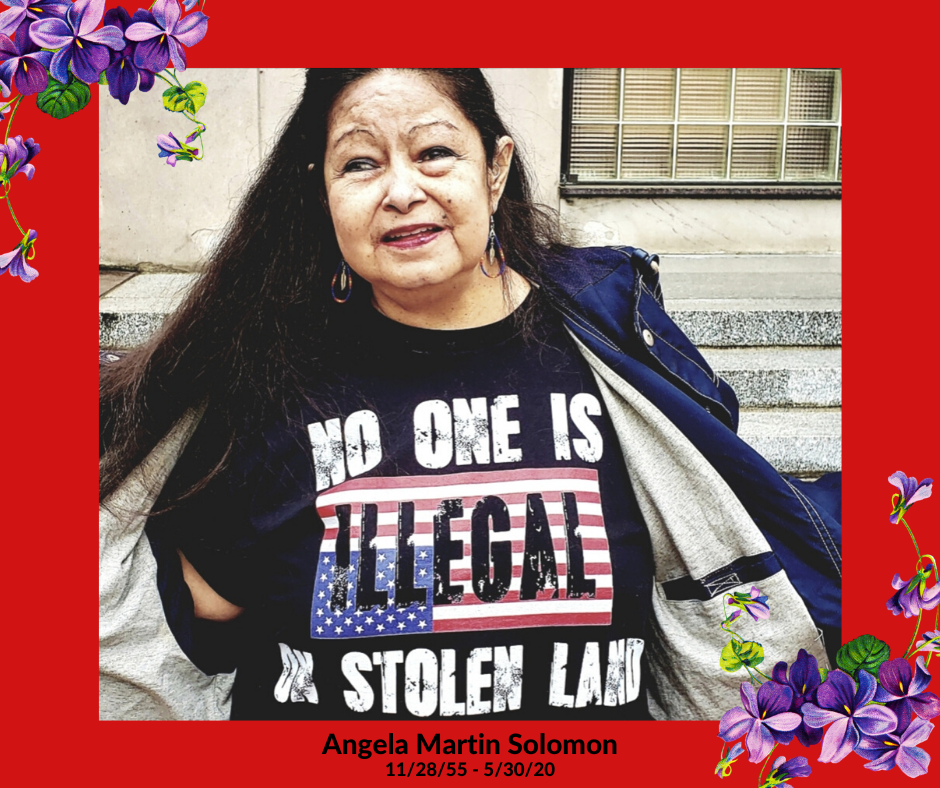
Remembering Angela Martin Solomon

Angela border name correct date.png

By Brenda Bentley

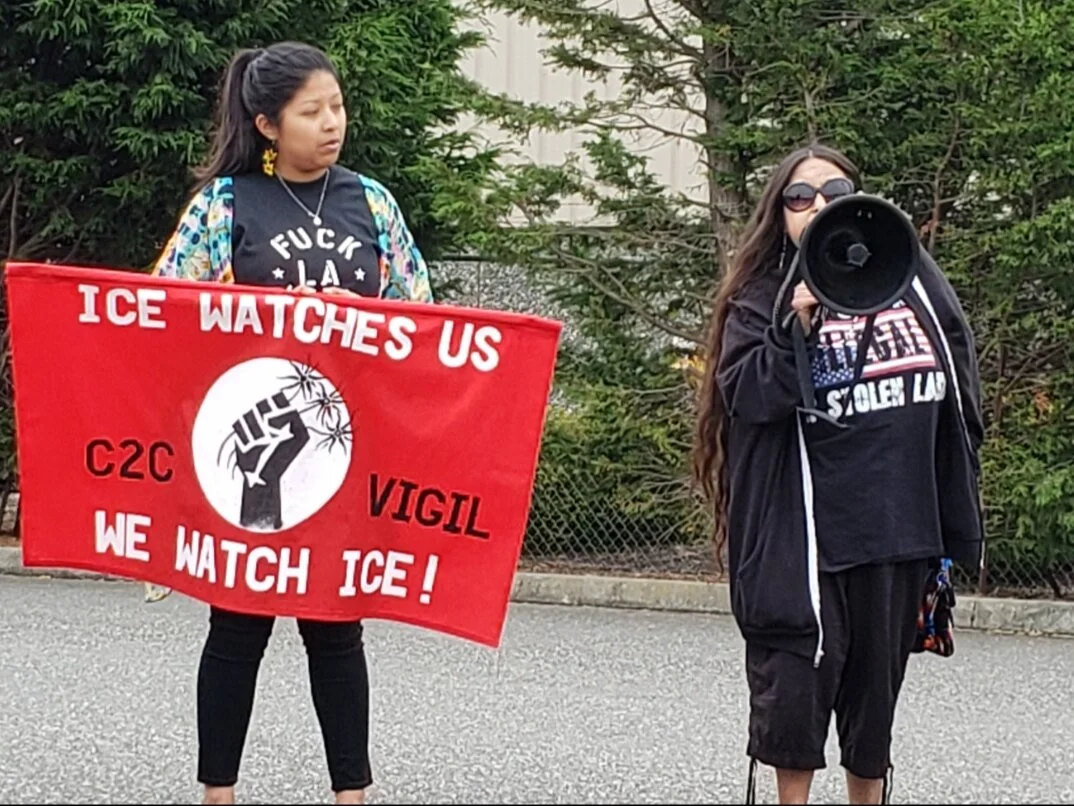
Angela Martin Solomon and I first met at the C2C Dignity Vigils that began in Feb. 2017 and lasted over 3 years. We were fighting to make Bellingham a Sanctuary City but the vigils would evolve to address the H2a Guestworker program and the death of "Guestworker" Honesto Silva Ibarra at Sarbanand Farm in Sumas. 

For over 3 years Angela was present every Monday in front of City Hall. If she missed a vigil I knew she was taking care of herself and would check in to see if she needed anything. In truth she looked after me with her Elderberry syrup and our hilarious FB chats.  Over the years we got to know each other carpooling to Tacoma or Seattle to support other activists. She was a leader in the Indigenous environmental justice movement and I learned that she had been kicked in the kidneys by police at a Seattle protest, causing permanent damage that left her with only one kidney. It's a testament to the brutality of law enforcement but more so to the unflinching bravery and big heart of Angela Martin Solomon. 

We lost a compañera in the movement and I lost a rare friend. It is a blow. Rest in power, Angela. We will not forget you!

In Angela's own words she tells us why she stood in solidarity with brown and black folks at C2C Dignity Vigils:

“I attend Dignity Vigils because I do not agree with what this so-called president is doing. Deporting people! I believe immigrants from other nations belong here. This is Turtle Island. We have NO BORDERS!”

03ee2cc4-5b8b-41a5-b4a5-b095cdd8dc1c.JPG
36da3cd4-43bf-4088-8d71-32b4a1ab96b7.JPG
240c7059-c281-42a5-8c0b-096b02745142.JPG
900670e8-7524-42ba-b3f5-94b894311ead.JPG
a73f2f4c-559d-4aad-aa62-62e0926afe62.JPG
a77a45f6-0429-4524-922b-25abd850305a.JPG
e67e3100-4d75-41d7-95d3-a4651ffb1098.JPG
0b0c1393-2044-4833-a3f4-09b5302bff8e.JPG

ANTONIO GONZALEZ PRESENTE!

Antonio at cooperativa tierra y libertad

Antonio at cooperativa tierra y libertad

After hearing the unexpected and sad news of  Antonio’s passing I began looking through my photographs to visit with this kind, down to earth human being who made a big contribution to C2C through his artwork.

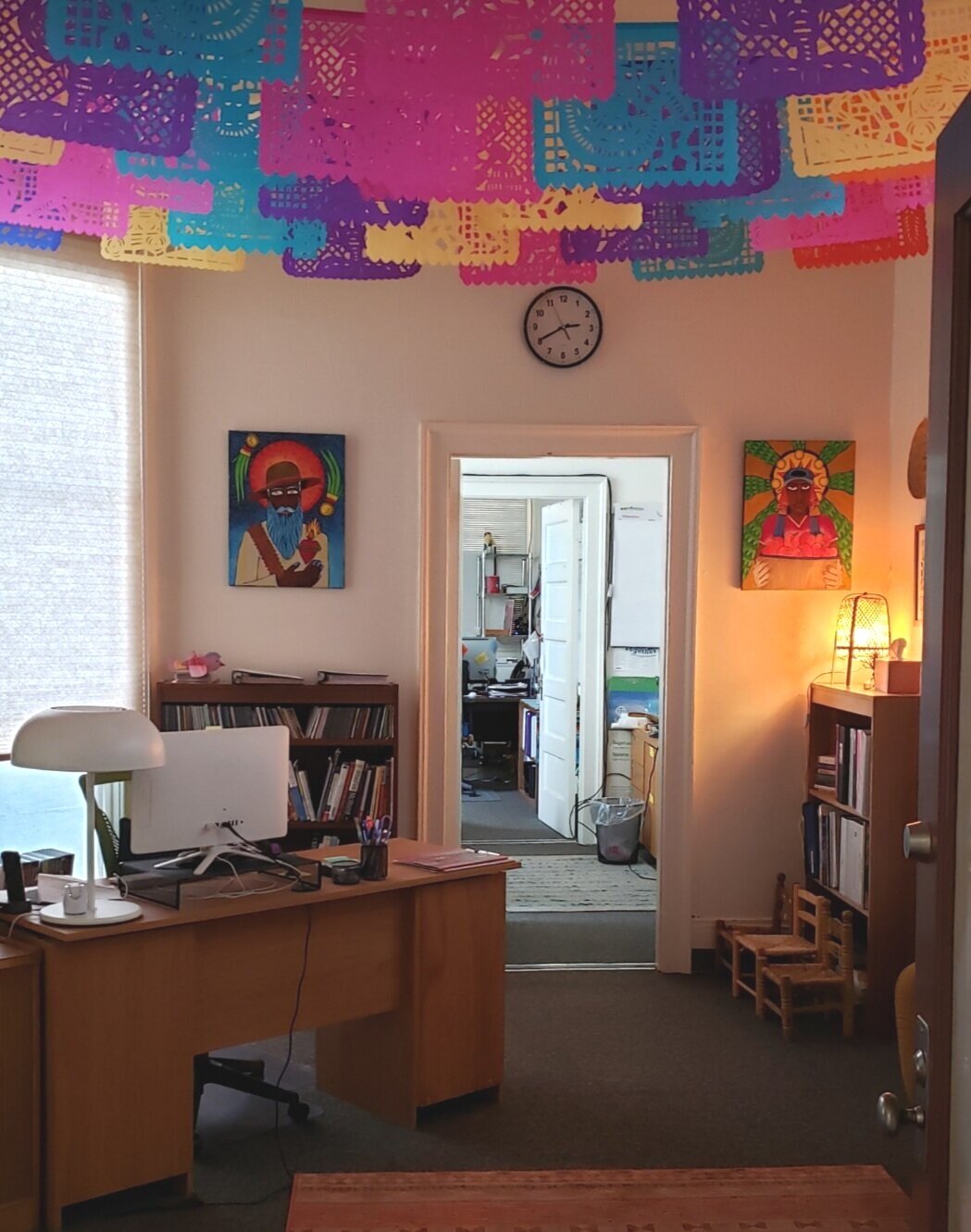
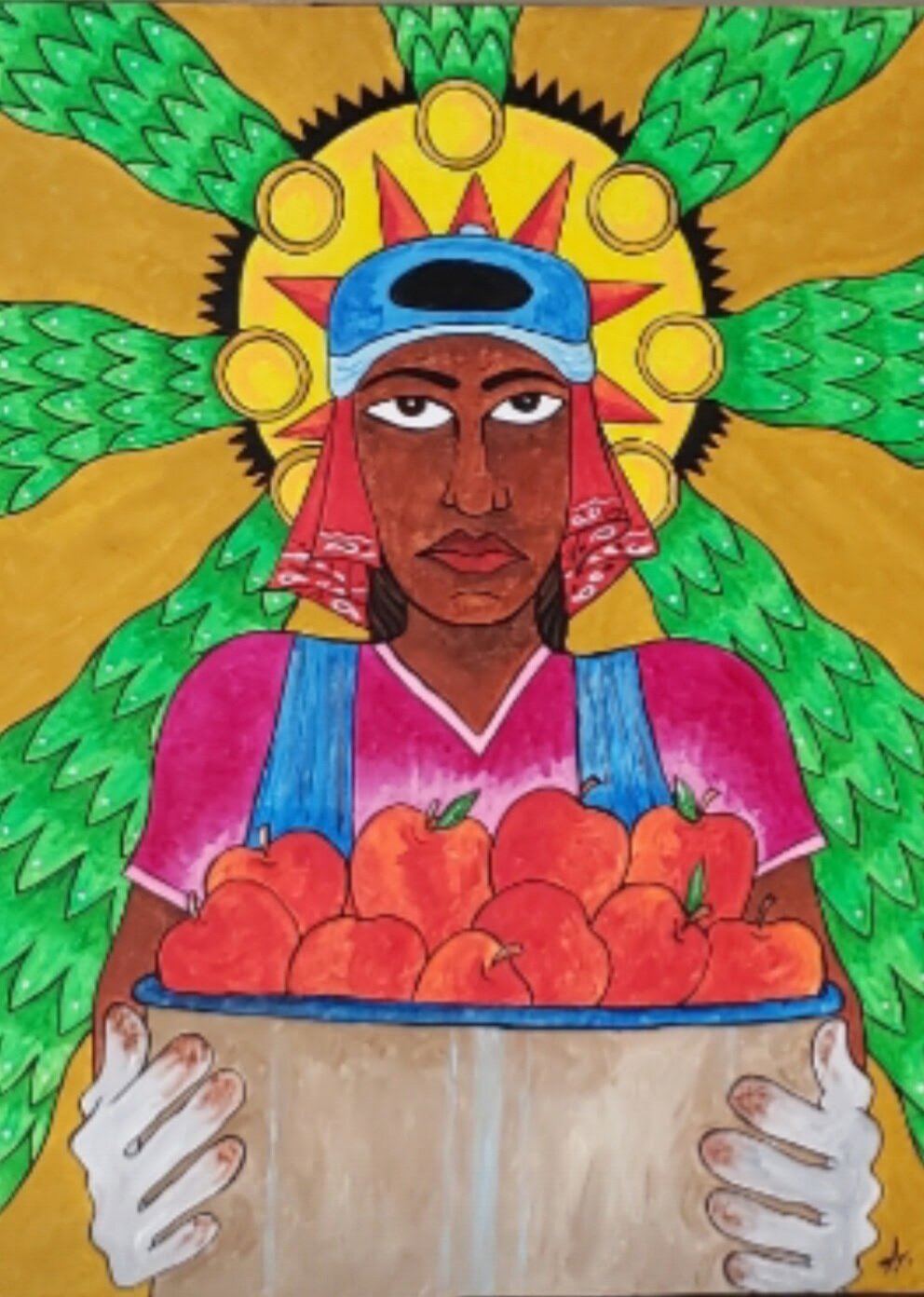
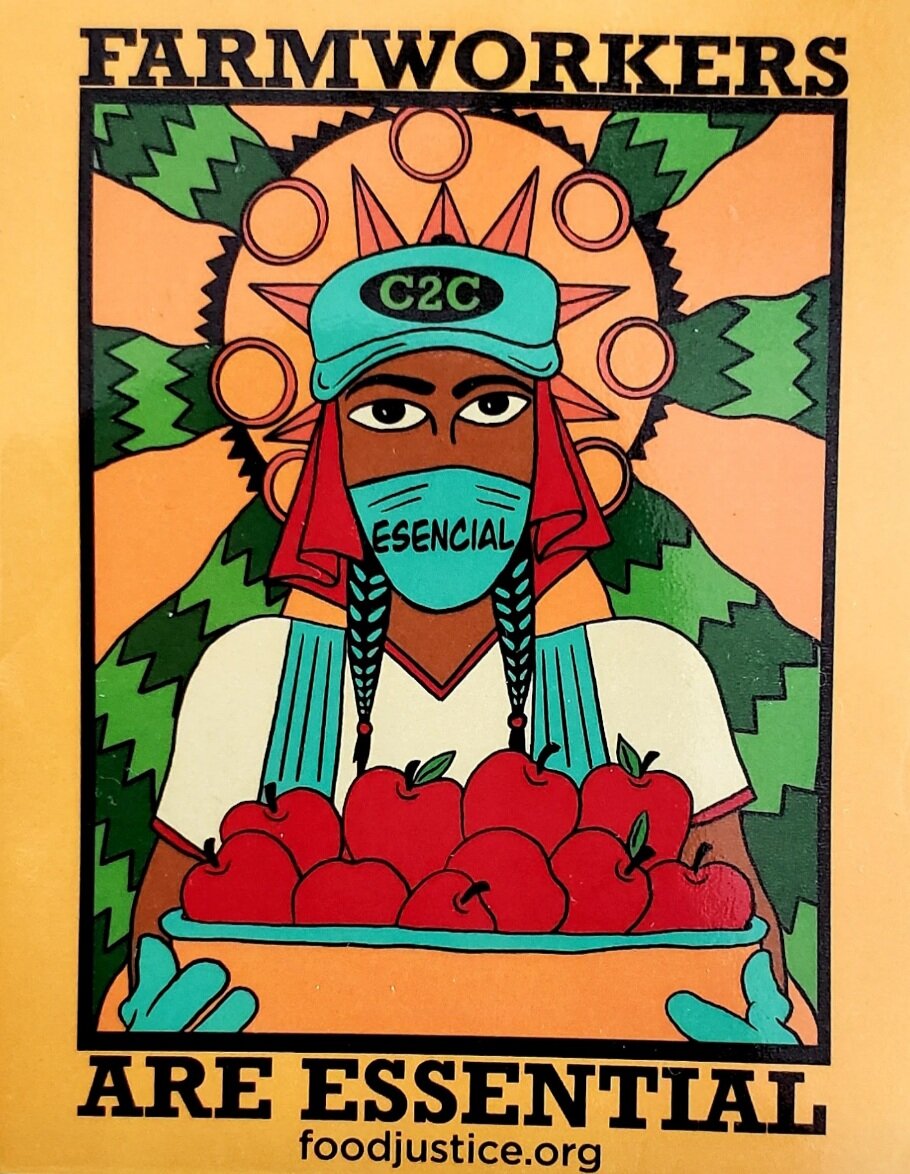
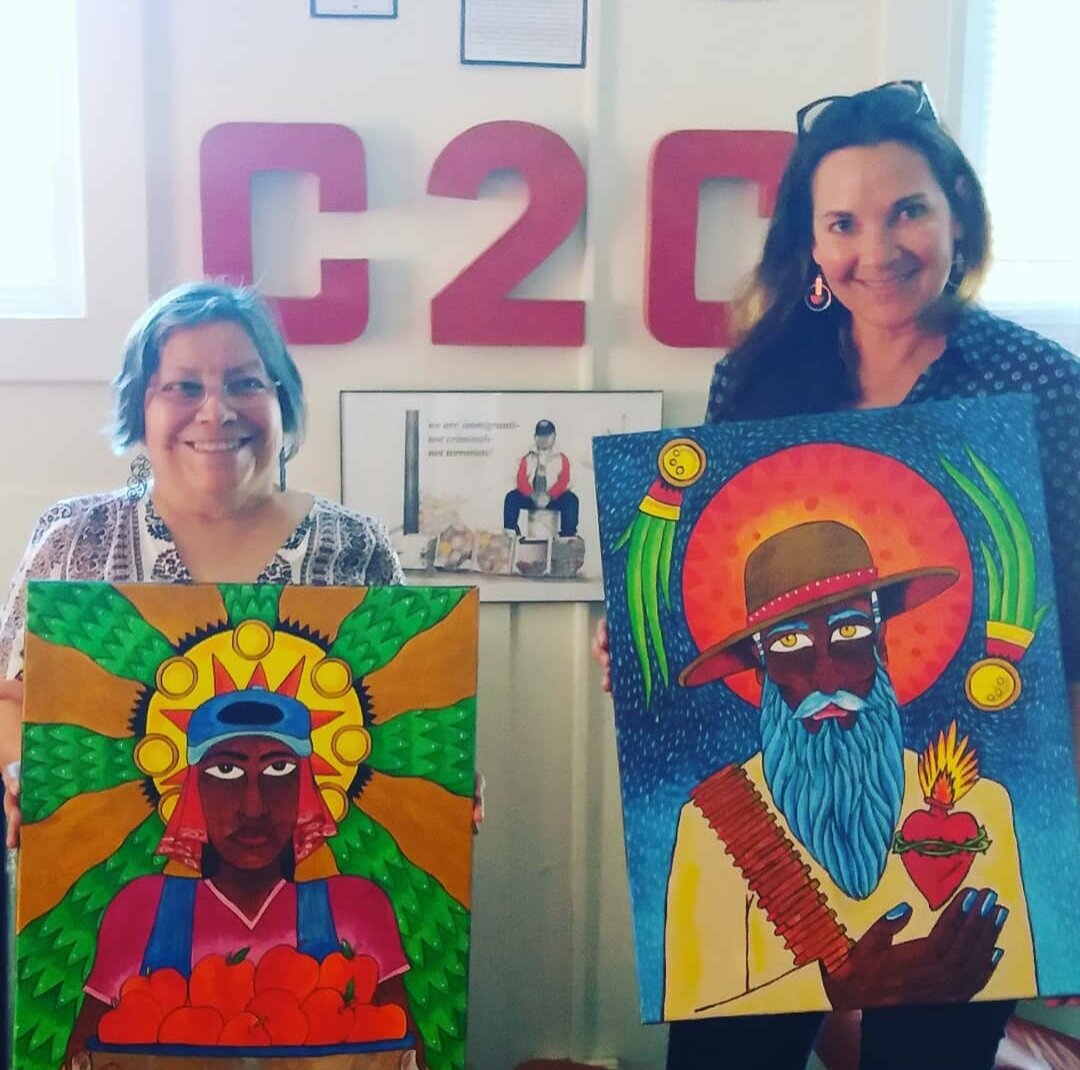
I was reminded that his presence is around us still. In our C2C Centro space in Bellingham you enter the reception that is filled with colorful papel picado hanging from the ceiling and features two of Antonio's paintings flanking a doorway. One of these paintings is titled Manzana Mama. This painting would be the basis for the Farmworkers are Essential image that highlighted the truth that during the Covid 19 pandemic farmworkers were deemed essential yet they were being treated as disposable. A Covid PPE mask now covered the face of Manzana Mama.

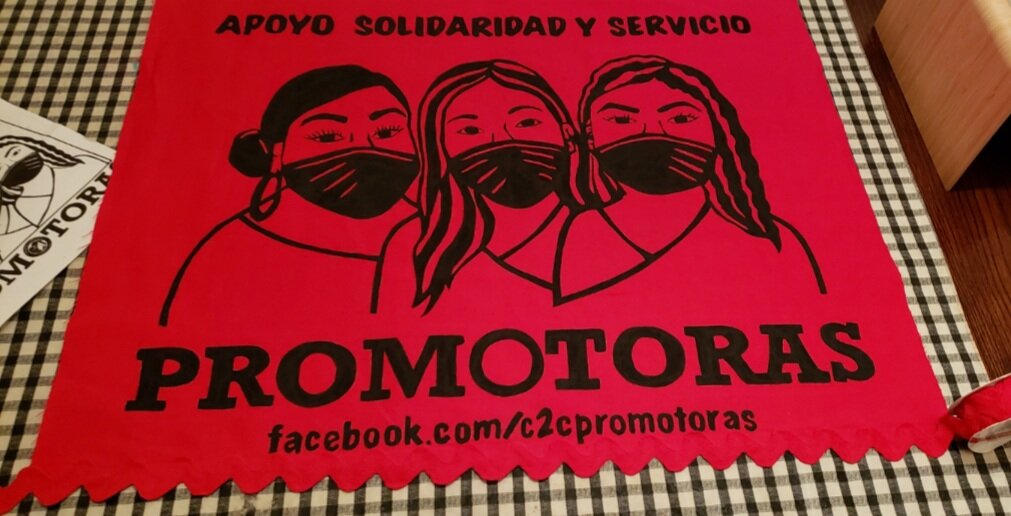
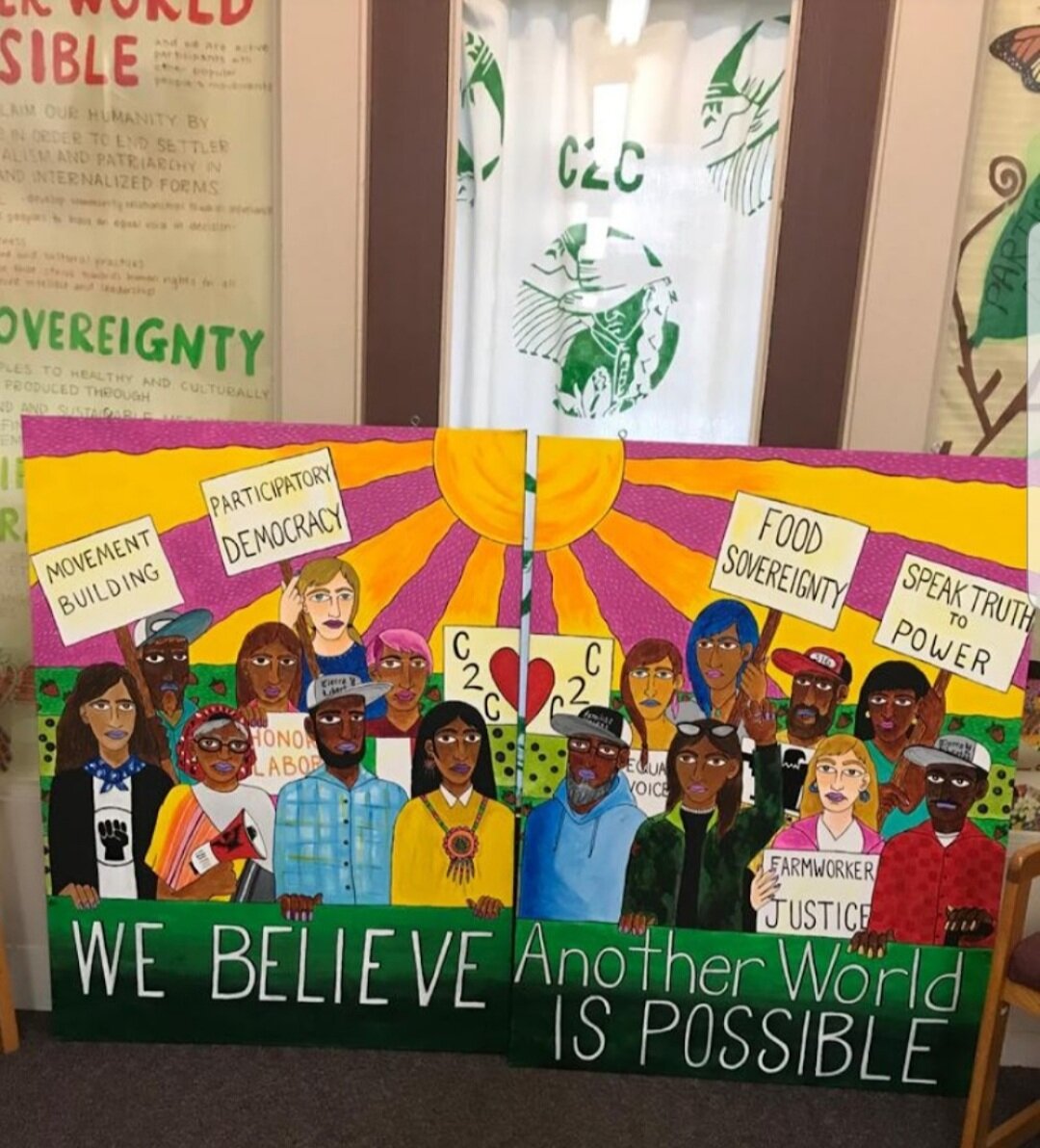
Antonio is also present in the delicate way he rendered the faces of the Promotoras for their logo and in our Social Forum room his large two-panel painting depicts members of our movement standing together in community. When we enter it centers us to the "we" rather than the "I".

Throughout this last year with social distancing and isolation we were able to meet only a few times. Usually outside a local bookstore where we would discuss a new project. Invariably talk would turn to our mutual fondness for collecting  him (junk) me (vintage) bric a brac.  Antonio was into Rat Rods (look it up) and we liked some of the same old school punk bands.

I always thought that we would have more time and that Antonio's work with us at C2C was just beginning. What I know of him is limited to the brevity of those few years but I  do know that his art, his faith and his family were at the core of everything he was.

 Antonio Gonzalez' life, his light, will continue to remind us that art, culture and artists themselves are very much essential.

Rest in Power Antonio.

You can listen to our tribute to Antonio on CommunityVOZ here.

The Legacy of the Braceros Makes Us All Braceros

By Rosa Martha Zárate Macías

Director and Spokesperson for the Alianza de los Braceros del Norte 1942-1964

Q. Why is it important for us to know about the Braceros?

The story of the Braceros will show the world how the impoverished communities are legally exploited, legally enslaved. In the case of the Braceros who came legally to this country, they came to support the United States in World War II with their arms, their brazos. Their history has to be known because of the injustices, the exploitation and the fraud committed against them, because the temporary worker programs are no more than a legalized way to forge the chains of slaves and thus violate workers’ rights and human rights.

That’s why we have to know about the Braceros because it shows how legally, the United States and other countries, their allies, used the temporary worker program to lure millions of men from the most impoverished sectors of Mexico and then exploited them for their goodwill and strength of arms.


Q. What are the legal issues we are dealing with? 

Braceros began organizing their movement in 1998. They believe they have a just claim against the Mexican government for the ten percent that was deducted from their salary by the US Department of Labor and farm owners. They are also bringing a case against the United States together with Mexico, for ignoring their demands seeking repayment of the historical debt owed to 4.6 million workers who came to this country to work in the agriculture industry and in the railroad industry. The Alianza was founded in 2007 to represent the Braceros residing in the US. Since then, members of the Red Binacional de Organizaciones de Ex Braceros has conducted a series of legal actions, taking their case to the United Nations, the Inter-American Commission on Human Rights, and the Permanent Peoples' Tribunal.* 


People in the U.S. should recognize their claims because the Braceros have not only been ignored but have been refused the compensation they are owed by the Mexican government and the Mexican banks who supposedly held the funds on behalf of the Braceros. Neither the United States nor Mexico have provided them with the documents necessary for their legal demands to move forward in order to obtain restitution for the nearly five million workers who became as Franklin D. Roosevelt called them, “soldados en los surcos,” that is, soldiers in the fields.


Q. What is the legacy of the Braceros?

The legacy of the Braceros, as we explain in the book, is very important to the history of the United States because their work made it possible for us to look back today and celebrate the victories in World War II. It is vital to get into the hands of the new generation, the granddaughters and grandsons of the Braceros, because it shows the price paid by their antepasados, their ancestors, so they could have a better life.


We can’t allow this new generation of Americans to forget what the Braceros endured: their willingness to leave home and family convinced they will have the possibility to better their lives. Their hard work in brutal and inhumane working conditions, the injustices, facing death from waiting for months to get a chance to be accepted, dying of hunger, incinerated, and buried in common graves and in the fields, and overall suffering discrimination and violation of their human dignity. The Bracero case was found by the Permanent Peoples' Tribunal to constitute a “case against humanity.”


The book has as one of its objectives, the recovery of the historical memory of the ancestral pilgrimage of our people, so the new generations assume their responsibility to participate in the building of a just society ¨with dignity and justice for all.” A people without historical memory will remain enslaved, subjected to the mechanisms of exploitation and domination. 


The values of courage, determination, looking for a better life, paying the price, all those are values no one can forget and that is one of the objectives of the book. The Braceros who didn’t go back to Mexico and now reside in the United States, have worked with us to assemble a testament, a will, a document, to say. “Never forget the way we were treated and never allow others to be enslaved as we were.”


The book is titled, Our Grandfathers Were Braceros and We Too/Nuestros Abuelos Fueron Braceros y Nosotros También because the people in control of the social system in which we live continue to exploit our labor force, our arms, our intelligence… we are the Braceros of today!


Q. There is a bill in congress right now, H-2A Temporary Agricultural Employment of Foreign Workers. What do you think of this legislation?

This is another goal, another objective of writing this book. Because in talking with the Braceros of the Alianza de Braceros del Norte from California, Nevada, Arizona, and Washington, it was decided that this book would set a precedent of how these temporary worker programs are a mechanism to keep enslaving people and to enforce this mechanism of exploitation. This proposed law has to take into account the Braceros’ story. We don’t want farm laborers to be victimized anymore nor have the exploitation of the past perpetuated. Any organizations involved in any way with the proposed legislation in Washington should take into account the half-century of struggle by the Braceros and be firm in watching and defending the rights of the temporary workers of today. 


Q. How will the members of the Alianza de Braceros del Norte benefit from the proceeds of the book?

Since early 2000, we have collaborated bi-nationally with the Braceros in Mexico. Since 2007, we decided to organize our own Alianza among Braceros living in US and assure that our Mexican constitutional rights are respected. Over that period, many authors, many historians, and other professionals have been interested in that history: they came to us, interviewed us, took our pictures, and we never heard back from them. My co-author, Abel Astorga Morales, and I, and the translator, Madeline Rios, decided to do better. So, whatever proceeds we get from the book will go to benefit the groups that participated in putting it together by their witness.


The money will be used for legal defense against both Mexico and the U.S. because the struggle continues, here and in Mexico. After 23 years, the governments in turn have not responded to the Braceros’ demand of justice. Thousands of the Braceros have joined the movement, most of them have died standing on the front line, the few survivors of the “Bracero Holocaust,” as they name their experience, are not ready to give up their fight until the historical debt is paid. 


We are inviting the children, the relatives of the Braceros to stand on the frontline and demand justice for their grandparents. 


Q. Tell us a little more about the book

This book, Our Grandparents Were Braceros and We Too/Nuestros Abuelos Fueron Braceros y Nosotros También is a bilingual edition. We have a photo album that reveals the way our grandfathers were treated, how they were sprayed with DDT, with pesticide. The strongest of them were chosen, as if they were selecting the best slaves. This book is for you and everyone in this country to learn and defend this struggle of the Braceros. We invite you to join the movement. 


We believe this book, which brings together primary documents of the time with firsthand accounts from people who worked in the Bracero Program, is a tremendous resource for anyone interested in labor rights history, and it exposes a dangerous precedent for migrant farmworker policies that continue to allow and condone abuses of workers today.


Rosa Martha Zárate Macías and Abel Astorga Morales are co-authors of Our Grandfathers Were Braceros and We Too/Nuestros Abuelos Fueron Braceros y Nosotros También. Madeline Newman Rios is the translator of the English version.


The book is a publication of Somos en escrito Literary Foundation Press. Copies are available from online retailers but we recommend ordering them through local bookstores and asking they carry the book for sale. Use the English title to order: Our Grandfathers Were Braceros and We Too. 


For more information or to contact Rosa Martha for interviews or presentations, contact editors@somosenescrito.com or call 510-219-9139.

______________________

Rosa Martha Zárate Macías, a native of Guadalajara, Jalisco, has resided in California since 1966. She was a primary school teacher in her hometown and later in San Ysidro, CA, earned a Bachelors in Music and in Pastoral Theology in Mexico, and studied under Paulo Freire in the U.S. and Mexico. As a singer-songwriter, she has participated in social justice actions in the U.S. since the 1960s. Cofounder of the Librería del Pueblo, an immigration and citizenship project in San Bernardino, she has collaborated in the founding of community, health, and alternative economy projects in the U.S. and Mexico. After two decades of supporting the campaign for justice of the Ex Braceros, she is also a proponent of the Binational Mi Abuelo Fue Bracero y Yo También project, whose aim is to establish educational programs for social change.


*Editor’s Note: The Permanent Peoples' Tribunal is an international People's Tribunal founded as a grassroots initiative in Bologna, Italy, on June 24, 1979, to make permanent the occasional tribunals held previously to denounce the crimes committed by the military regimes in Latin America.
The Farm Workforce Modernization Act Sets Dangerous Precedents for Workers

FCWA is a coalition of worker-based organizations whose members plant, harvest, process, pack, transport, prepare, serve, and sell food, organizing to improve wages and working conditions for all workers along the food chain. In 2019, farmworker members of FCWA opposed the Farm Workforce Modernization Act because we believed it would set dangerous precedents, divide workers, and ultimately make conditions even more difficult for farm workers across the country. 

The FWMA was introduced under the Trump administration and expands the H-2A program without providing necessary oversight or adequate protections, and makes e-verify mandatory for all agriculture employers.  It excludes many workers from a pathway to status, sets up a very long path to finally acquire residency status, and requires farmworkers to continue working in agriculture for up to 8 years to qualify. 

We join with undocumented workers across the country in calling for comprehensive immigration reform in 2021. As part of this reform, we need a broad and expansive vision of farmworker rights. We support President Biden’s goal of providing immediate green cards for farmworkers who have sacrificed so much during COVID to ensure our food security; however, we will continue to strongly oppose any bill that  will create more vulnerable conditions for farmworkers in the workplace. It is not the time to revive legislation crafted under the Trump administration, giving huge concessions to the grower lobby by linking the h2a program to immigration reform. Immigration pathways should not be used to allow for labor exploitation of immigrant workers.   

Our farmworker members have a long history of organizing with farmworkers across the US and Canada. As an Alliance, we believe that regardless of immigration status, all farmworkers deserve dignity, respect, and full protection on the job and in the communities in which their families reside. It is our belief that our movement should be guided by this vision of expanding access to rights and protection for all workers, especially the right to organize.  FWMA moves us in the opposite direction, and that is why FCWA and our farmworker members continue to oppose this bill.
FCWA es una coalición de organizaciones de trabajadores cuyos miembros plantan, cosechan, procesan, empacan, transportan, preparan, sirven y venden alimentos, y están organizándose para mejorar los salarios y las condiciones laborales de todos los trabajadores a lo largo de la cadena alimentaria. En 2019, los trabajadores agrícolas miembros de FCWA se opusieron a la Ley de Modernización de la Fuerza Laboral Agrícola (FWMA) porque creíamos que sentaría precedentes peligrosos, dividiría a los trabajadores y, en última instancia, haría que las condiciones fueran aún más difíciles para los trabajadores agrícolas en todo el país.


La FWMA se introdujo bajo la administración de Trump y expande el programa H-2A sin proporcionar la supervisión necesaria ni las protecciones adecuadas, y  hace que la verificación electrónica sea obligatoria para todos los empleadores agrícolas. La FWMA excluye a muchos trabajadores de un camino para estatus legalizado, establece un camino muy largo para obtener el estatus de residencia, y requiere que los trabajadores agrícolas continúen trabajando en la agricultura hasta por 8 años para calificar.

Nos unimos a los trabajadores indocumentados de todo el país para pedir una reforma migratoria integral en 2021. Como parte de esta reforma, necesitamos una visión amplia y expansiva de los derechos de los trabajadores agrícolas.Apoyamos el objetivo del presidente Biden de proporcionar tarjetas verdes inmediatas a los trabajadores agrícolas que han sacrificado tanto durante el COVID para garantizar nuestra seguridad alimentaria; sin embargo, continuaremos oponiéndonos firmemente a cualquier proyecto de ley que cree condiciones más vulnerables para los trabajadores agrícolas en el lugar de trabajo. No es el momento de revivir la legislación elaborada bajo la administración Trump, dando enormes concesiones al lobby de los productores lingo el programa H2A con una reforma migratoria . Las vías de inmigración no deberían utilizarse para permitir la explotación laboral de trabajadores inmigrantes.

Nuestros miembros trabajadores agrícolas tienen una larga historia de organización con trabajadores agrícolas en los EE. UU. Y Canadá. Como coalición, creemos que independientemente de su estatus migratorio, todos los trabajadores agrícolas merecen dignidad, respeto y protección total en el trabajo y en las comunidades en las que residen sus familias. Creemos que nuestro movimiento debe guiarse por esta visión de ampliar el acceso a los derechos y la protección para todos los trabajadores, especialmente el derecho a organizarse. FWMA nos mueve en la dirección opuesta, y es por eso que FCWA y nuestros miembros trabajadores agrícolas continúan oponiéndose a este proyecto de ley.


A RESPONSE TO THE WAR MACHINE BEING ACTIVATED BY OUR LOCAL GOVERNMENT 

“This is absolutely the moment to engage in the kind of educational activism that might help to encourage all of us, especially those of us who live in the most vulnerable neighborhoods, to purposefully rethink the meaning of safety and security.” - Angela Davis 2020

Community to Community Development recognizes that the military action taken on Thursday January 28th against the houseless people and their advocates on the people’s property is a violent action taken against all of us. As advocates for farmworkers and immigrant families we call out to our allies and supporters to reject the logic that these actions were and continue to be taken to “protect” us. We are in a moment of clear and present danger from white supremacist militias and right-wing delusional groups like Q’Anon. The Mayor and Interim Police Chief decided, without the people’s voice, to call in multiple county, state and federal enforcement agencies, with weapons meant for war. We find it extremely offensive that the city and county called on the Border Patrol to assist them in waging violence on vulnerable communities. We have heard many denials of a cooperative relationship between the Bellingham Police Department and federal immigration officials, yet nothing could be clearer than what we saw last Thursday. 

It cannot be overlooked that during the summer of 2020, white supremacist militia groups occupied downtown Bellingham in response to the Black Lives Matter movement. When the community called on the city to protect us from the danger of armed white supremacists on our streets, the response was negligible. This is a clear demonstration of institutional racism.

If there is a real and credible threat to our community, the government has a responsibility to let the people know what that threat is. We call on our community to join us in demanding transparency from the city and the county on everything that they have done in this situation, from attempting to silence dissent during public comment at city council meetings, to authorizing Customs and Border Patrol to join the Bellingham Police Dept. for the armed attack on January 28th, to maintaining a militarized presence on the rooftop of the police station throughout the weekend.

In the weeks since November 11th we have watched as houseless folks began to gather and camp on the lawn at City Hall. This situation is not new. Every winter we hear the voices in our community calling out for the city and county government to take action and create sustainable housing for those who need it most. This housing crisis has resulted in a growing population of homeless folks in Whatcom County. This winter houseless people have been even more vulnerable and exposed due to COVID-19. We have witnessed the city and county government prioritize temporary restructuring of the Downtown Business District. We did not see the same strength of effort for protecting human lives from the pandemic. 

We saw the mayor and city council ignore the pleas of advocates and unanimously pass a budget prioritizing the police department while there were houseless people on the lawn at City Hall. There is a pattern of ongoing political willfulness and organized discipline of ignoring vulnerable community’s voices. We have experienced this political behavior in trying to establish policies to protect immigrant families in Whatcom County and in the establishment of the County Council as the County Health Board. We are concerned about future efforts of the Immigration Advisory Board. The result of years of advocacy and direct action has been the establishment by ordinance of this Board. Our goal is still to provide safety, equity and opportunity for immigrant families. Given this violence using Border Patrol, we again question the professional relationship of the Bellingham Police Dept with Homeland Security.

Community to Community Development was founded to advocate alongside farmworkers, immigrants and their families and work towards improving our communities by striving together for equity, basic rights, safety and most of all recognition of our humanity and the dignity of our labor. In the 17 years since our founding, we have given voice to our communities’ grievances and suffering at the local, state and federal levels. Our grievances have been very public. We have used our First Amendment Rights many times. We have been very clear in many spaces; for our community to live well, we seek to abolish systems that have institutionalized racist structures and normalized violent behavior.  Black, Brown and Indigenous, poor and houseless residents have been asked to testify about this violence many times throughout the years. People have exposed themselves to retaliation because there was hope that these structures would be transformed into just institutions with equitable community participation. Hope that in working together, following a peaceful, orderly process, our communities would be safer, healthier and have more opportunity for a good life. While we present our realities to elected officials, Bellingham Police Officers and County Sheriff’s Officers continue to racially profile Black, Brown and Indigenous people, place police officers in our schools, and create an environment where many community members cannot trust law enforcement. The city has allowed local law enforcement to become increasingly militarized, using our tax dollars to normalize this militarization. 

We urge our friends and supporters to imagine a world where community resources are spent on solutions to homelessness instead of violent posturing. While the justification may be ambiguous references to threats, consider the threat to our freedom and autonomy that this militarized presence poses. Consider the message that is being sent to those who would dare dissent in any way while surrounded by tanks and guns, with helicopters circling overhead and snipers on the roofs in our neighborhoods. We can envision community safety as it relates to job satisfaction, connection with the earth and each other, safe housing, fair working conditions and freedom from incarceration, detention and deportation. There are many ways to work toward solutions that do not include militarized intimidation and violence. We have all the resources we need; it is the way these resources are being distributed that is causing the suffering. As an organization we recognize the challenge before us, that includes continuing to take on  the hard work of moving away from a reliance on this hyper-violent response to suffering, toward solutions that build a stronger more equitable community. We recognize this moment of political extremes. Please join us in holding our elected leaders accountable for such extreme violence and ensure it does not happen again as we build toward a better future for all of us.

Photo credit: Sattva Photo